
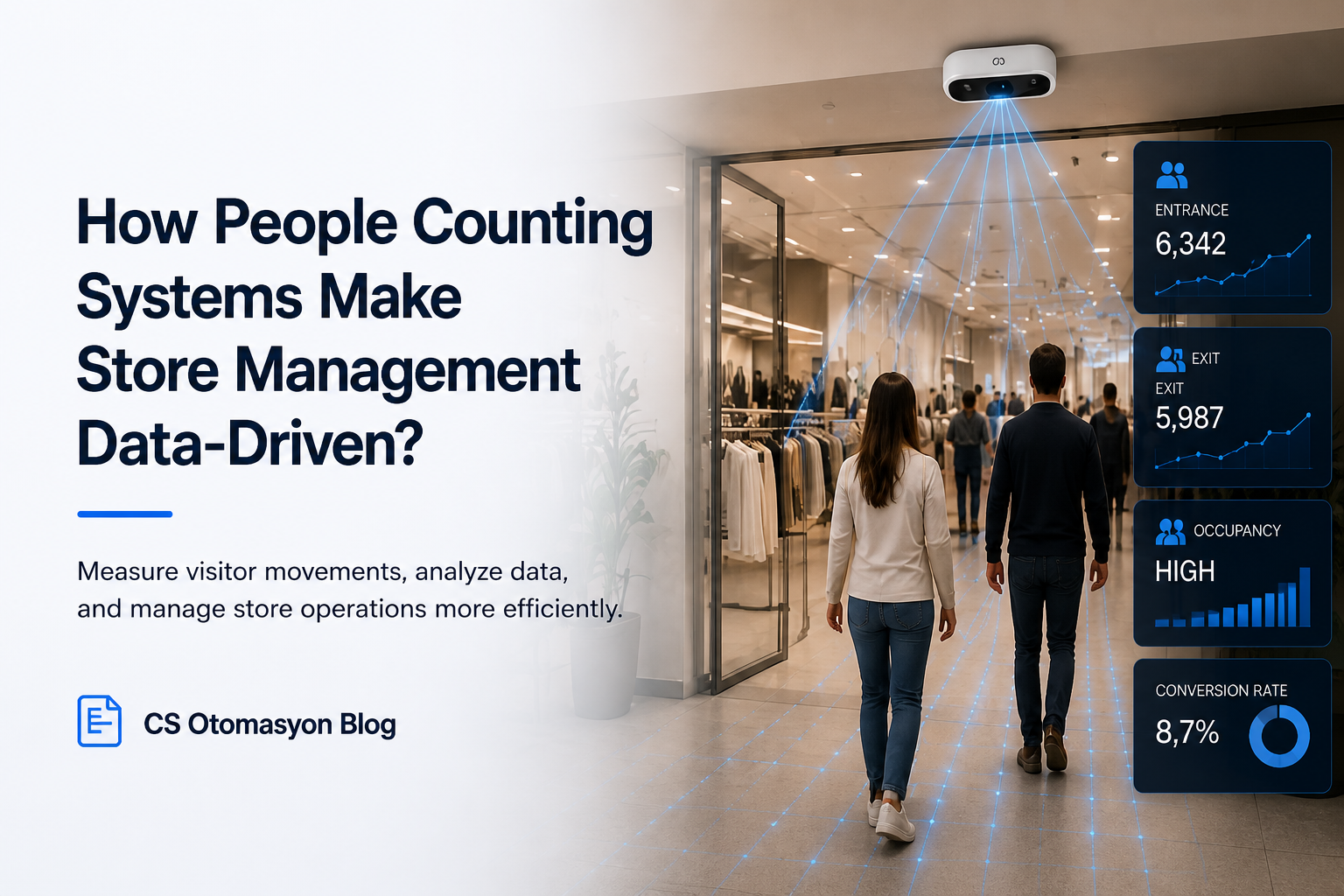
People Counting Systems for Data-Driven Retail
What Do People Counting Systems Add to a Store?
A people counting system automatically measures visitors passing through a defined entrance or passage point. In physical stores, sales transactions are visible, but the traffic of visitors who leave without purchasing often remains unseen. These systems record entry and exit movement over time and create a traffic view of the store.
With the right installation, the data can support more than a total count: it can reveal hourly traffic patterns, peak periods, and comparisons across locations. For the underlying technology, read how a 3D people counting sensor works.
Data Flow: From Sensor to Operational Decision
- Measurement: The sensor detects entry and exit direction within the defined counting area.
- Reporting: Traffic data is reported by hour, day, store, or selected period.
- Comparison: Peak periods, stores, and campaign periods are compared.
- Action: Workforce planning, service capacity, and campaign evaluation are updated using the data.
Which Operational Questions Can It Support?
- When does a store receive its highest visitor traffic?
- Why do similar locations differ in traffic and conversion?
- Did physical traffic actually change after a campaign?
- Are staffing and checkout capacity sufficient during peak periods?
For the management-side KPI interpretation, see our guide on measuring store performance. Calculating conversion rate with sales data requires people counting data and POS integration.
Accuracy, Scope, and Privacy
Counting quality is influenced by sensor placement, entrance width, simultaneous passage, and installation calibration. A project should therefore define counting zones and acceptance criteria before rollout, followed by sample checks in live use. People counting data should support traffic and operational measurement rather than identifying individuals. For the anonymous-data approach, see privacy-compliant people counting systems.
Implementation Approach
A successful implementation begins with the right business question: Is the priority traffic, peak periods, store comparison, or conversion analysis with POS? The team can then define device placement, reporting cadence, and data ownership. In multi-store businesses, a pilot helps validate KPI definitions and reporting practices before wider rollout.
Conclusion
People counting systems turn physical-store traffic into an operational input that teams can use in decisions. Combined with the right KPI framework and business processes, the technology makes store management more measurable.