
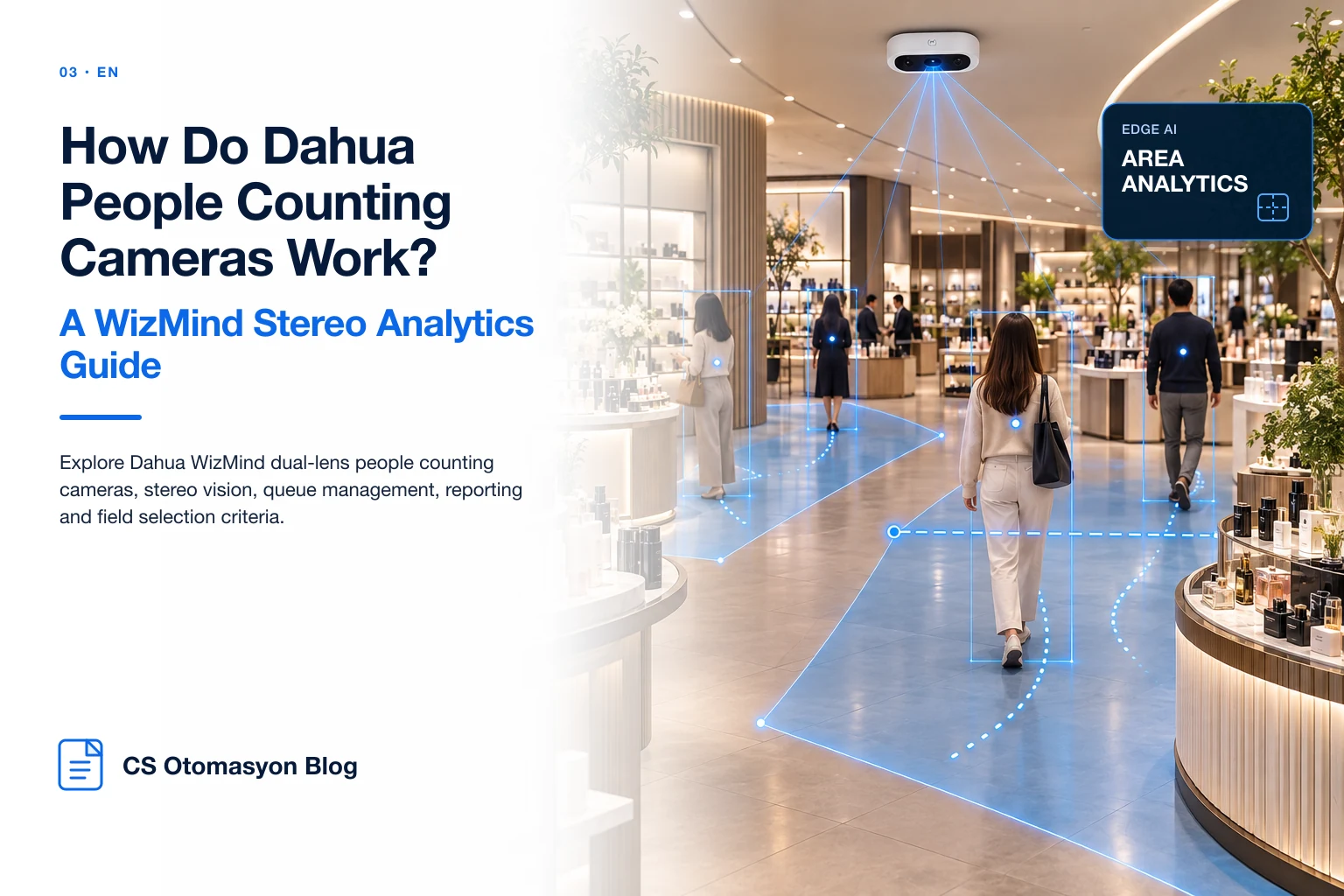
How Do Dahua People Counting Cameras Work? A WizMind Stereo Analytics Guide
Search intent and context
Dahua describes IPC-HDW8441X-3D as a 4 MP WizMind Dual-Lens People Counting Network Camera combining binocular stereo vision with deep-learning algorithms.
Technology and analytics capabilities
Published capabilities include area counts, entry/exit/pass counts, queue management and daily/monthly/yearly reports.
Limitations and field criteria
A dual-lens camera is not automatically best for every site; very high ceilings, wide entrances, outdoor exposure or privacy priorities may favor a dedicated 3D/ToF sensor.
Procurement / integration decision
In an existing Dahua estate, test whether each view is suitable for accurate analytics rather than assuming every camera can become a footfall counter.
What dual-lens analytics provides in the field
A dual-lens design uses differences between two optical views to support depth estimation. Instead of relying only on a 2D silhouette, the analytics can reason about a person relative to the floor and directional movement. Dahua explicitly combines binocular stereo vision with deep-learning algorithms in the IPC-HDW8441X-3D positioning.
Stereo, however, does not compensate for poor geometry. Lens choice, mounting height, counting line, perspective and traffic density still need to remain inside the intended operating envelope.
Line counting, area counting and queue management are different measurements
Counting a person across a virtual line, measuring how many people remain inside an area, and monitoring queue behaviour are separate analytics problems. Even when the same device supports all three, the rule geometry, reporting periods and operational thresholds should be configured differently.
Occupancy may be useful for capacity, while a real-time queue threshold is useful at checkout. A central dashboard should preserve these meanings rather than hiding every metric under one generic “people count” label.
Working with an existing Dahua estate
If an organization already operates Dahua cameras and recorders, the analytics project should begin with an inventory of streams, firmware, PoE capacity and event/metric interfaces. Replacing cameras before understanding that estate can create unnecessary cost.
Some general video-analytics use cases may reuse existing streams, while precision retail footfall can justify a dedicated overhead counter. Both architectures can coexist within the same enterprise.
What to capture during a pilot
A pilot should record more than a single percentage. Measure entry and exit errors separately, distinguish peak and quiet periods, and log U-turns, groups and direction mistakes. A small directional bias can accumulate into a large occupancy error over time.
Keep mounting height, lens, firmware, rule screenshots and test context with the result. That documentation makes the outcome reproducible at the next branch.
The CS Otomasyon approach
In an existing Dahua estate, CS Otomasyon first inventories cameras and streams, then separates use cases that can reuse existing video from those that need a dedicated dual-lens counter. Pilot results and data requirements drive the design rather than brand habit.
FAQ
Can WizMind count people?
Selected models can; capabilities must be verified by model and firmware.
Can Dahua data feed a central dashboard?
Yes, where supported interfaces are available and validated.
Is area counting the same as net occupancy?
They are related, but accumulated entry/exit occupancy and instantaneous zone counts are different measurement methods.
Does queue management require a separate camera?
It depends on geometry and model capabilities; a dedicated view of the queue can be more reliable.
Can Dahua analytics feed external systems?
The supported export or API method should be verified for the exact model and platform.
Conclusion and CTA
Choose the technology against the real entrance geometry and target KPI rather than the logo on the device. A site survey and controlled pilot with CS Otomasyon can validate the architecture before rollout and connect the resulting data to centralized reporting.