
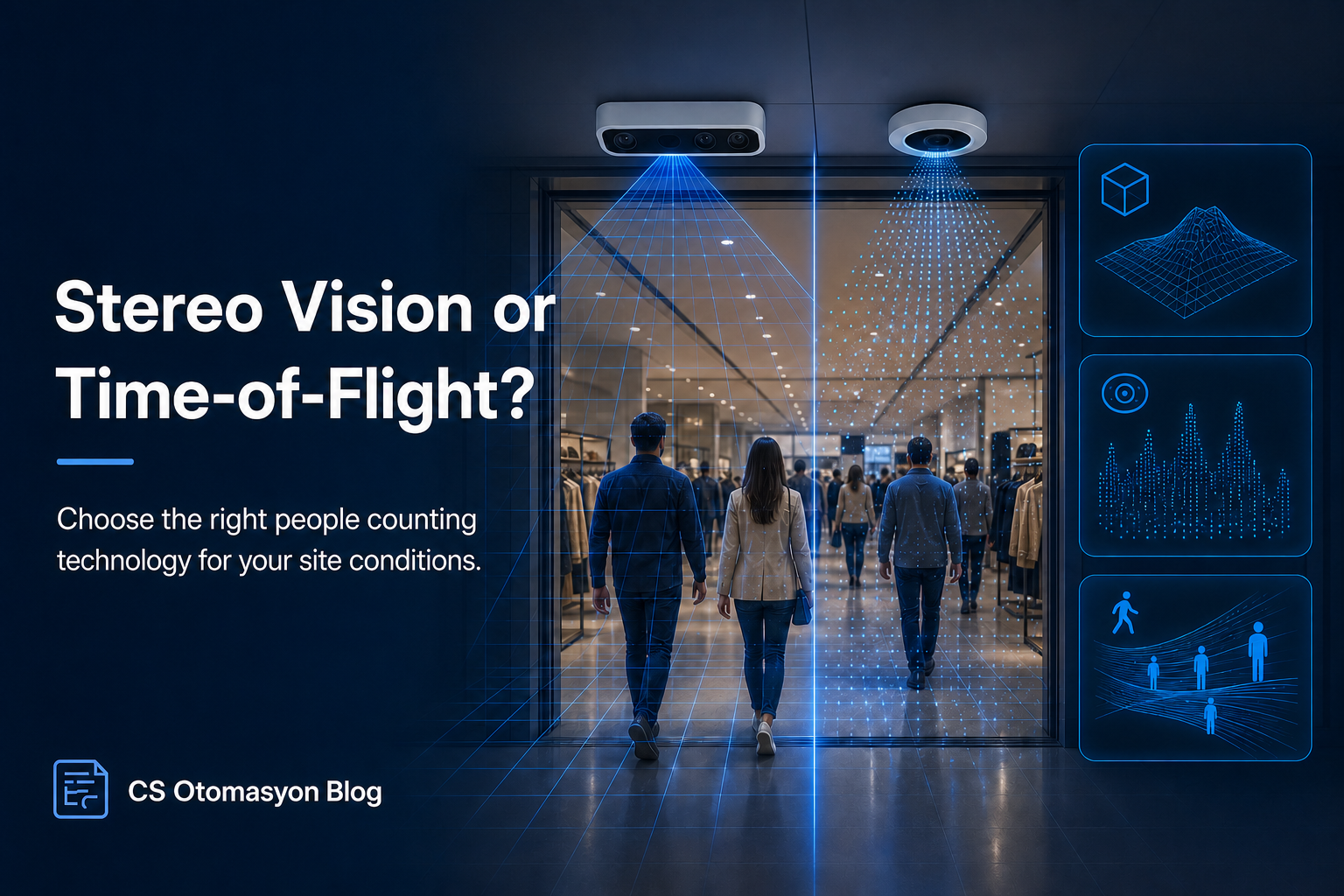
Stereo Vision or Time-of-Flight? How to Choose the Right People Counting Technology
Determining the Most Suitable Hardware Infrastructure for the Project
When installing people counting systems in large retail chains, shopping malls or public buildings, the most important step that determines project success is choosing the right hardware. The most common mistake in the sector is trying to install a standard, one-size-fits-all sensor, such as only a 2D camera or only thermal, across all stores with different physical structures, ceiling heights and lighting conditions. Today, the most precise systems use Stereo Vision and Time-of-Flight (ToF) technologies that create 3D depth maps. Although both have high accuracy potential, their engineering principles make each stronger in different environmental conditions.
Stereo Vision: How It Works and Strengths
Stereo Vision technology, as the name suggests, imitates human depth perception. The device has two camera lenses placed at a defined distance from each other. These two lenses see the object from different angles and create a three-dimensional depth map based on pixel shift (disparity).
- Wide Coverage Area: Thanks to high-resolution lenses, a single sensor can cover very wide door openings by itself (wide FOV - Field of View).
- Height Separation and Shape Perception: It can distinguish whether visitors are children or adults, or whether they carry shopping carts/luggage, through visual size and shape processing capability.
- High-Ceiling Performance: Stereo Vision products can offer different lens and mounting options. Usability in high-ceiling areas such as airports and malls should be evaluated according to supported mounting range, entrance width, lens selection and field calibration.
Time-of-Flight (ToF): How It Works and Strengths
Time-of-Flight technology is based on a completely different physical principle. The device sends infrared (IR) light pulses into the environment. The time between this invisible light traveling downward, hitting an object and returning to the device is calculated at nanosecond level to create a 3D point cloud of the environment.
- Reduced Dependence on Lighting: Because it uses its own IR source, dependence on visible ambient light can be reduced. However, direct sunlight, reflective surfaces, sensor range and environmental geometry can affect performance; suitability should be validated by product and site.
- High Privacy Focus: ToF sensors do not capture true-color (RGB) video; they produce only grayscale points indicating height and distance. Compared with color video, this data structure may provide a privacy-focused approach that reduces identification risk. However, KVKK/GDPR compliance does not depend only on sensor type; data purpose, access, retention, integration and governance processes must be evaluated together.
- Low-Ceiling Stabilization: In boutique stores with very low ceilings, it can produce a reliable depth map even at narrow angles.
Critical Comparison and Selection Matrix
Basic comparison criteria that can be used when making project decisions:
- Ambient Lighting: If the store entrance receives intense direct sunlight during the day or counting is required in darkness at night, ToF sensors may be advantageous.
- Entrance Width: For a very wide store door, using multiple ToF sensors and combining them in software (stitching) may be costly; in this case, using a single wide-angle Stereo Vision device may be more efficient.
- Floor Reflections: On highly polished marble or tile floors, ToF infrared signals can bounce; in such challenging floors, visually analyzing Stereo Vision may remain more stable.
Limitations and Accuracy Rates
Accuracy rates vary by product, field geometry, mounting height, lighting conditions, crowd density and calibration method. Performance values stated in manufacturer documents should not be used as definitive project-wide results without field acceptance testing. Even the most expensive technology, if positioned incorrectly (too tilted or obstructed), will produce incorrect counts.
CS Otomasyon Approach
CS Otomasyon does not impose a single hardware brand on customers. During comprehensive site survey, the physical architecture of your facility is reviewed. When necessary, Stereo Vision can be used at the main entrance of the same store, while ToF sensors are used in a low-light warehouse passage, consolidating all data in a single central software platform.
Field Testing and Technology Acceptance Criteria
Values in technical documents are a starting point for selection; the final decision should be made, whenever possible, through discovery and pilot testing under real field conditions. Glass doors, shiny floors, sunlight, directional signs, strollers, group passages or staff movement at the entrance may create results that differ from laboratory conditions.
In the acceptance test, daily totals should not be the only comparison. Busy and quiet hours, people passing side by side, reverse-direction movement, U-turns and waiting at the entrance should be sampled separately. Who will perform the manual reference count and in which time interval should be defined in advance.
- Coverage: The sensor sees the entrance opening without leaving blind spots.
- Direction accuracy: Entry, exit and return movements are correctly classified.
- Object filtering: Staff, strollers or shopping carts are handled according to the project rule.
- Data continuity: Data loss is monitored after network interruption and reconnection.
- Privacy: The generated data is evaluated against purpose, access and retention policies.
This method helps choose the most suitable solution for a specific entrance and use case, instead of declaring Stereo Vision or ToF generally superior.
Product Documentation and Maintenance Requirements
Products in the same technology family can differ in range, field of view, protection class and processing capacity. Therefore, selection should not be made only by the label "Stereo Vision" or "ToF"; the current technical document, supported mounting height and environmental conditions of the proposed model should be reviewed. Manufacturer limits should also be validated for outdoor environments, intense sunlight, humidity, dust or vibration.
- Installation: Mounting point, cabling, network and power requirements.
- Calibration: Rechecking when entrance geometry or field layout changes.
- Health monitoring: Offline status, image blockage and data interruption alerts.
- Maintenance: Lens cleaning, connection checks and periodic reference counts.
In the purchasing decision, maintenance access, warranty, spare parts and technical support duration should be considered as much as first installation cost. Field-validated acceptance criteria separate technology selection from marketing claims and help preserve expected data quality throughout the system's lifetime.
FAQ
Do Stereo Vision cameras work in the dark?
Most Stereo devices need a minimum level of ambient lighting (lux). For analysis in complete darkness, the environment must be illuminated.
Can ToF sensors be used outdoors?
In outdoor areas exposed to direct intense sunlight, natural infrared rays from the sun can overpower the sensor signals (IR saturation). Special protected outdoor Stereo or Lidar systems should be evaluated for these scenarios.
How do the two technologies compare in price?
Although costs vary by brand and model resolution capacity, TCO (Total Cost of Ownership) should be calculated based on the total number of sensors needed to cover the doorway according to project size.
Is it possible not to include children in the count?
Yes. Since both technologies create 3D depth, height filters such as "do not count movements below 120 cm" can be applied through the software interface.
Conclusion
Achieving the high accuracy rates targeted in your project starts with selecting the right sensor technology that matches the field's physical dynamics. To define the most suitable hardware architecture for your infrastructure, you can start a discovery process with the CS Otomasyon technical team.