
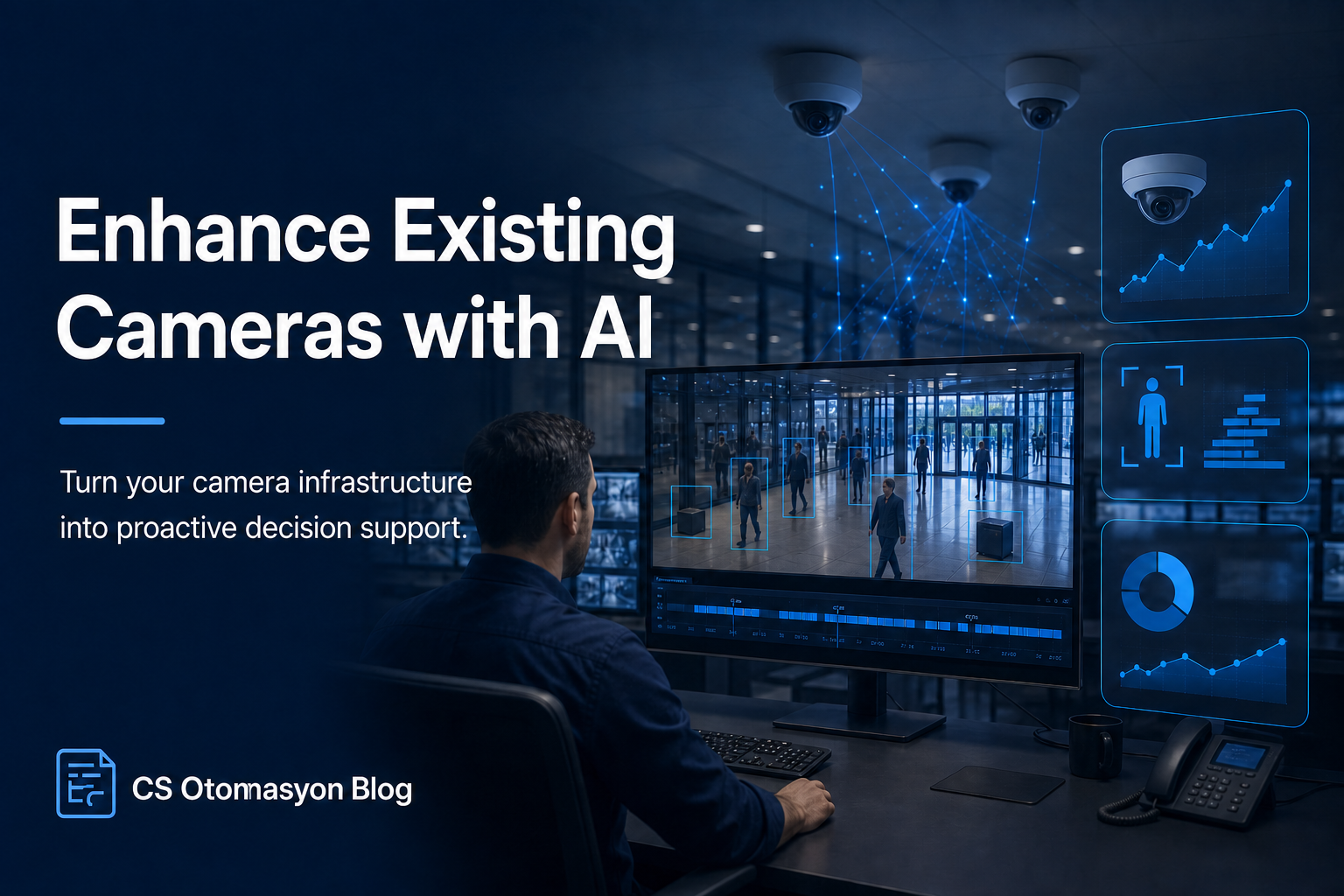
How Can Existing Security Cameras Be Turned into AI-Powered Video Analytics?
Protecting and Functionalizing Existing Infrastructure Investment
Today, factories, shopping malls, logistics warehouses and public buildings have huge CCTV networks containing hundreds or even thousands of security cameras. However, a large share of these cameras work as passive recording devices: they only capture video, record it to disk and are used to search historical evidence after an incident such as theft or an accident. It is impossible by human nature for security operators to monitor dozens of screens at once without error. Many facility managers assume that gaining artificial intelligence (AI) capabilities requires removing all existing cameras and installing expensive smart cameras, and therefore avoid this transformation because of high budgets. However, CS Otomasyon Video Intelligence Platform approaches have the potential to turn your existing IP cameras into proactive alert systems based on evaluating the analytics capacity of the camera infrastructure.
How Transformation Works: Edge and Core Architecture
The basic way to add intelligence to existing cameras is for the camera to continue acting only as an eye, while the brain function is moved to external hardware or a server. This architecture is generally built with two different methods:
- Central Analytics Servers (Central GPU Servers): RTSP (Real-Time Streaming Protocol) video streams from existing IP cameras are transferred over the local network to central analytics servers with high processing power (GPU) located in the system room. This method is suitable for dense centralized analysis of hundreds of cameras with different AI scenarios.
- Edge AI Devices: In remote points where network infrastructure or bandwidth is insufficient, small industrial AI boxes (Edge AI Box) are placed near the camera or in the field panel. Video is processed on this box, and instead of large video files, only small text messages and image frames related to the violation moment are sent to the center.
Field Assessment and Camera Suitability
Not every old camera can turn into a perfect AI sensor. For the system to produce healthy data, cameras need to meet certain standards. During project discovery, the following parameters are reviewed:
- Resolution and Frame Rate: Required resolution and frame rate are determined by the image size of the object to be detected and its movement speed; 1080p or a specific FPS value is not a standalone sufficiency criterion for every project.
- Camera Angle and Height: For example, a camera used for crowd counting should look from above near ceiling level, while a camera that will read vehicle plates or face/helmet details must look from a narrower angle closer to eye/bumper level.
- Ambient Lighting and Night Vision: Whether the cameras' infrared (IR) lighting (night vision) illuminates objects clearly is analyzed.
Applicable Analytics Scenarios
Existing cameras integrated with suitable infrastructure can become capable of producing proactive alarms in many scenarios, including:
- Unauthorized area violation (trespassing) and virtual tripwire crossings.
- Detection of abandoned suspicious packages or missing valuable objects.
- Vehicle direction violation, incorrect parking or stationary vehicle (loitering) detection in the field.
- Machine-pedestrian dangerous proximity in occupational safety scenarios. See occupational safety tracking.
Real Use Case: Perimeter Violation at a Logistics Center
A logistics company with a large open storage yard uses existing PTZ and Bullet security cameras to prevent intruders climbing over fences at night. However, theft incidents occur when security staff fall asleep in front of screens or lose attention. The facility manager integrates an Edge AI Server into the server room without changing the cameras. Virtual red lines are drawn over the cameras' field of view through software. At 03:00, when a human silhouette crosses this line, the system uses AI to verify whether it is a cat/dog or a person. If it is classified as a person, the alarm and event clip defined within the project can be delivered to the operator screen. Proactive intervention is made at the moment the event occurs.
Limitations and the Essential Role of Human Review
The greatest challenge in AI analysis with existing cameras is False Positive management. In conventional cameras, dirty lenses, cobwebs, tree branches moving in strong wind or heavy fog can mislead algorithms. Therefore, the goal of the system is not to remove the human element completely, but to focus human attention only on prioritized and filtered events. Operator verification of incoming alarms is always part of the system.
CS Otomasyon Approach
CS Otomasyon does not ask you to discard your existing investment. Our platform has compatibility potential with many IP camera models that support standard RTSP and ONVIF protocols. We support designing a parallel and isolated decision support network by evaluating options to work with your existing VMS (Video Management System - Milestone, Genetec, etc.) infrastructure.
What Should Be Checked During Technical Discovery
The suitability of existing camera infrastructure for video analytics cannot be determined only by looking at resolution. The angle at which the camera sees the target area, the pixel area occupied by the object in the image, frame rate, compression level, night image and network continuity should be evaluated together. A camera placed at a wide angle for security purposes may not provide enough detail for a specific analytics scenario.
During discovery, VMS and NVR licenses, RTSP stream count, user permissions, network segmentation and server capacity are also evaluated. The analytics server receiving the live stream should not violate the current working order of the recording system or cybersecurity policy.
- Image suitability: Angle, resolution, FPS, light and visual obstructions.
- Stream suitability: Supported protocol, codec and simultaneous stream capacity.
- Network suitability: Bandwidth, latency, VLAN and access permissions.
- Processing capacity: Camera count, analytics model and hardware resources.
- Operational design: Who will verify the alarm and what action will be taken.
If possible, the pilot implementation should cover daytime, nighttime and adverse weather conditions. Success should be measured not only by event detection, but also by missed events, false alarms and operator response time. This approach enables evidence-based decisions instead of replacing all cameras from the start or assuming the existing infrastructure is definitely sufficient.
Cybersecurity and Access Design
Opening video streams to a new analytics server changes the network and access surface. Therefore, default camera passwords should not be used, and service accounts should access only the required streams. The camera, recording system and analytics server should be positioned in segments appropriate to network policies whenever possible, and access should be logged.
- Credentials: Strong passwords, permission limits and regular key rotation.
- Updates: Supported version tracking for camera, VMS and analytics components.
- Connection: Closing unnecessary external access and limiting allowed endpoints.
- Retention: If event footage is kept, defining policy according to purpose and duration.
Before go-live, information technology and information security teams should approve the architecture. The stability of the recording system or current security controls should not be weakened for the sake of analytics functionality. Regular health monitoring helps detect connection interruptions and unauthorized configuration changes early.
FAQ
Can analog cameras (AHD etc.) be integrated with AI?
Although they cannot be connected directly, analog signals can be converted into digital IP streams (RTSP) with video encoders and transferred to the AI server.
Do we need to change our VMS software or recording device (NVR)?
Change may not be required in every project. If the existing VMS or NVR is suitable in terms of stream sharing, user authorization, licensing and network capacity, the AI analytics layer can work in parallel. The final decision should be made after technical discovery and compatibility testing.
Does AI analysis create bandwidth congestion on our network?
When central analytics is selected, cameras may continuously load the network; therefore, network traffic should be managed by setting up a VLAN independent from the main network or by using Edge analytics approaches.
Can AI produce false alarms in rainy or snowy weather?
Modern deep learning models are much more resistant than older-generation systems against rain, snow and wind because they look for object form rather than pixel change, but performance drops can occur under heavy environmental conditions.
Conclusion
Supporting suitable camera and network infrastructure with video analytics can help make events visible earlier and help security teams prioritize. For technical discovery and project design of your existing camera infrastructure, you can contact the CS Otomasyon team.