
What Is FootfallCam? How 3D People Counting and Retail Analytics Work
Search intent and context
FootfallCam Pro2 combines overhead 3D sensing with AI video analytics and targets a broader retail measurement model than simple entry counts.
Technology and analytics capabilities
Its current framework includes in/out, outside traffic, group counting, visit duration, age and gender, and staff exclusion, with availability depending on configuration.
Limitations and field criteria
FootfallCam’s Turkey page references Atakule and Watsons Turkey, making the brand a meaningful local organic search opportunity.
Procurement / integration decision
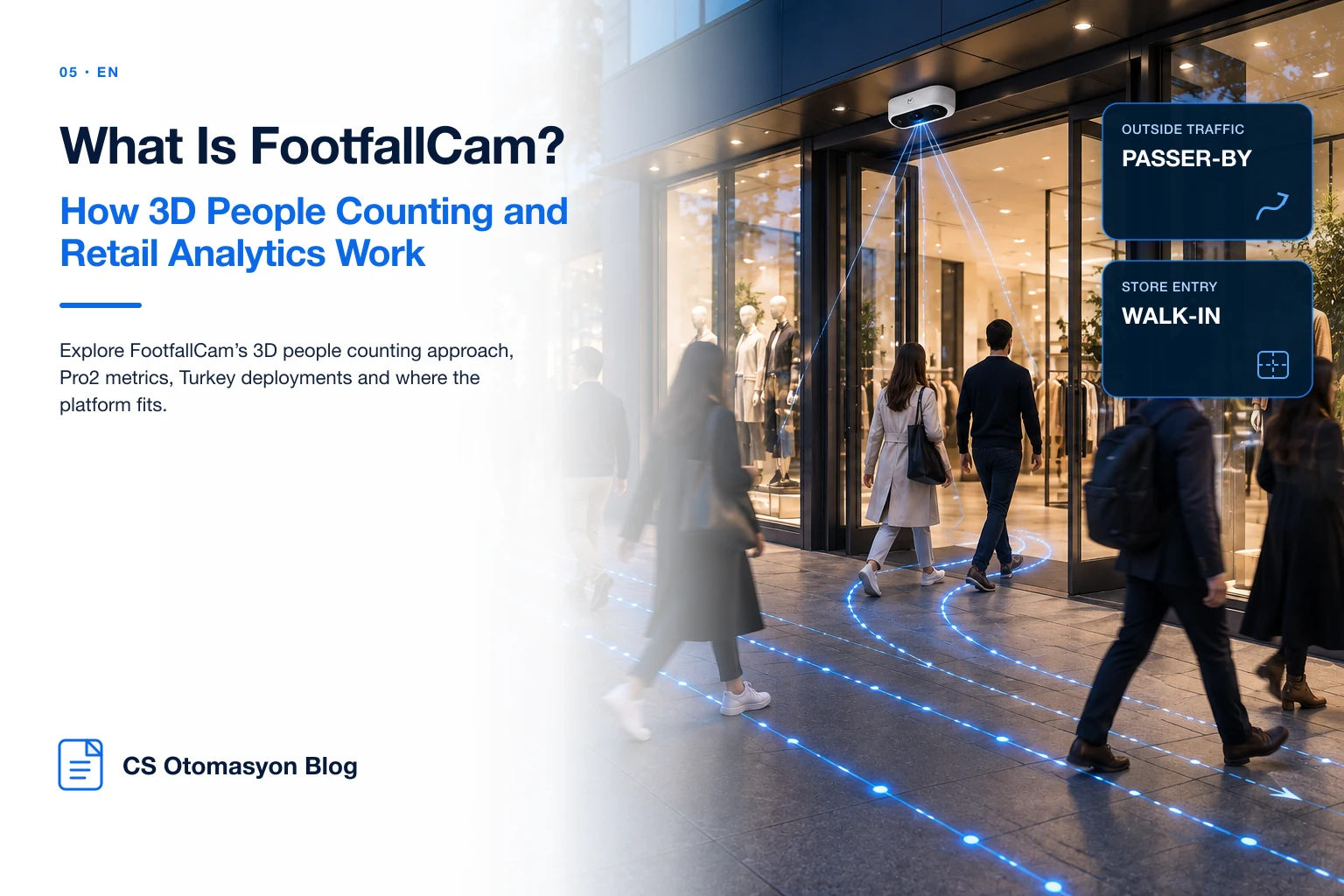
Outside traffic can support storefront capture-rate analysis by comparing passers-by with actual store entrants.
Moving footfall beyond a doorway tally
Platforms such as FootfallCam are interesting not only because of the hardware name but because they frame footfall together with outside traffic, visit duration, group counting and staff exclusion. That moves physical retail closer to a funnel model.
When passer-by traffic is available, a retailer can ask: how many people passed the storefront, how many entered, and how many purchased? Those stages help separate location attraction from in-store sales execution.
Why edge processing and privacy are part of the discussion
Current Pro2 documentation describes on-device processing with aggregated metrics sent downstream during normal operation. The architectural goal is to produce operational measurements without continuously transporting raw video to a central platform.
Privacy still depends on the actual configuration. Enabled metrics, integrations, retention and access control should be documented instead of relying on a generic product statement.
When outside traffic becomes useful
For high-street stores, mall corridors and storefront optimization, passer-by traffic is an important upper-funnel signal. If entry remains flat while outside traffic rises, capture may be weakening; if entry rises with stable outside traffic, storefront attraction may be improving.
The area outside a store is more complex than a doorway. People can linger, walk past repeatedly or cross the sensor zone on the way to another destination, so outside-traffic measurement needs its own calibration.
Footfall data governance in a store network
Across many branches, data integrity matters as much as device accuracy. Store openings, changed opening hours, device swaps and connectivity incidents should be visible in the central record so operational changes are not confused with data-quality problems.
A mature footfall architecture includes device-health monitoring, missing-data alerts and versioned KPI definitions. The next layer is joining those metrics with sales and other operational sources.
The CS Otomasyon approach
For a customer researching FootfallCam, CS Otomasyon looks beyond the counter to outside traffic, staff exclusion, data ownership, APIs, licensing and central KPI use. The real deliverable is the layer that connects footfall measurements to store decisions.
FAQ
Does FootfallCam only count people?
No. Depending on configuration it can support outside traffic, visit duration and staff exclusion.
Is it used in Turkey?
The vendor’s Turkey page lists Atakule and Watsons Turkey examples.
Are outside traffic and turn-in rate the same?
Outside traffic is passer-by volume; turn-in or capture rate expresses how much of that traffic becomes an entry.
Does edge processing continue if the internet fails?
Local counting may continue depending on architecture, but buffering and later data delivery should be verified.
Can FootfallCam data be joined with POS?
Yes, when APIs and store/time identities are aligned consistently.
Conclusion and CTA
Choose the technology against the real entrance geometry and target KPI rather than the logo on the device. A site survey and controlled pilot with CS Otomasyon can validate the architecture before rollout and connect the resulting data to centralized reporting.