
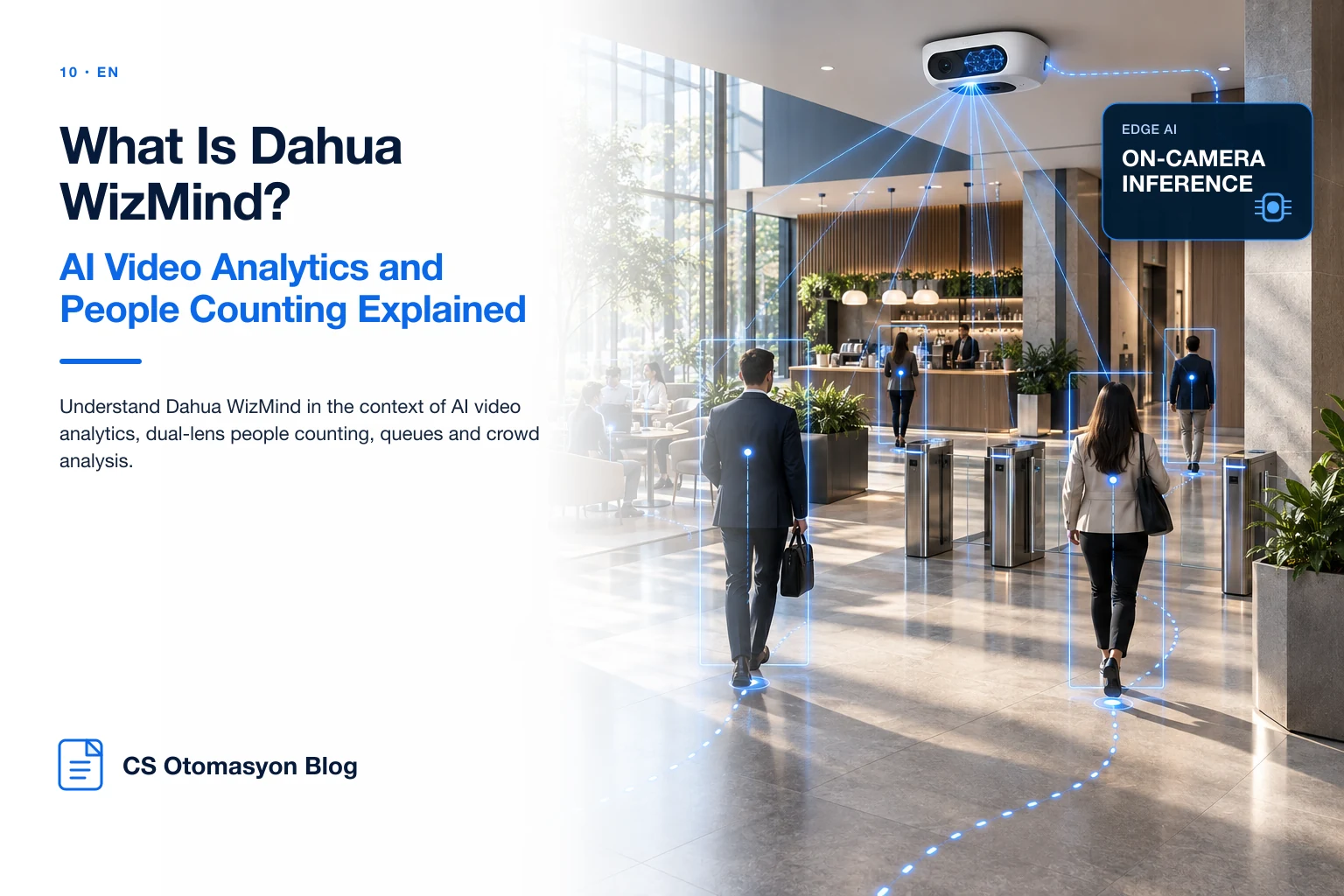
What Is Dahua WizMind? AI Video Analytics and People Counting Explained
Overview and context
WizMind is not one analytics feature; it is Dahua’s broader AI-oriented product family, and not every WizMind model supports the same people-counting functions.
Technology and analytics capabilities
Edge analytics can reduce central GPU and raw-video transport requirements in some designs, but API and firmware capabilities still constrain long-term integration.
Limitations and field criteria
People counting, queue management and crowd detection can support staffing and capacity decisions.
Procurement / integration decision
Procurement should verify model, firmware, mounting, low-light behavior, API/event output, VMS/NVR compatibility and lifecycle.
Why model-level verification matters inside WizMind
A broad AI family name does not define one fixed feature set. Devices can expose different combinations of perimeter analytics, face features, crowd, queue or people counting, so integration documentation should record the exact SKU and firmware.
That discipline avoids the assumption that “a WizMind camera must count people”. The relevant people-counting rule, report export and API/event behaviour should be confirmed before rollout.
Edge AI versus centralized AI architecture
With edge analytics, the camera processes video locally and sends an event or metric, which can reduce bandwidth and central GPU requirements. Centralized analytics receives RTSP streams and can apply one algorithm across different camera brands with model updates managed in one place.
The approaches can coexist: a dedicated edge counter for precision footfall, central AI for existing CCTV, and one reporting layer above both.
Firmware and analytics lifecycle
When AI runs on the device, firmware becomes part of the measurement lifecycle. An update can fix defects, change rule behaviour or affect API output. Large deployments should validate upgrades at a test site before phased rollout.
Inventory should track analytics version as well as online/offline status so KPI changes can be traced to the software state of each branch.
Setting the right expectation for retail KPIs
An AI camera can consolidate security, crowd and selected counting functions, but a financially important conversion KPI still needs a defined accuracy and installation acceptance test.
The systems perspective focuses on reliability of the business measurement rather than the marketing label on the device.
The CS Otomasyon approach
In WizMind projects, CS Otomasyon verifies model and firmware capability instead of relying on a family name. Edge and centralized AI are considered together, and the required KPI accuracy is tied to a pilot acceptance criterion.
FAQ
Does every WizMind camera count people?
No. Capabilities vary by model.
Does edge analytics eliminate servers?
It can move processing to the camera, while centralized reporting may still require a platform.
Must edge AI send all video centrally?
No. Depending on the architecture, only events or metadata may be sent while recording is designed separately.
Can firmware updates affect KPIs?
Yes if analytics or event behaviour changes, which is why staged validation is recommended.
Can AI cameras and dedicated counters coexist?
Yes. Different measurement classes can feed one platform.
Conclusion
Choose the technology against the real entrance geometry and target KPI rather than the logo on the device. A site survey and controlled pilot with CS Otomasyon can validate the architecture before rollout and connect the resulting data to centralized reporting.