
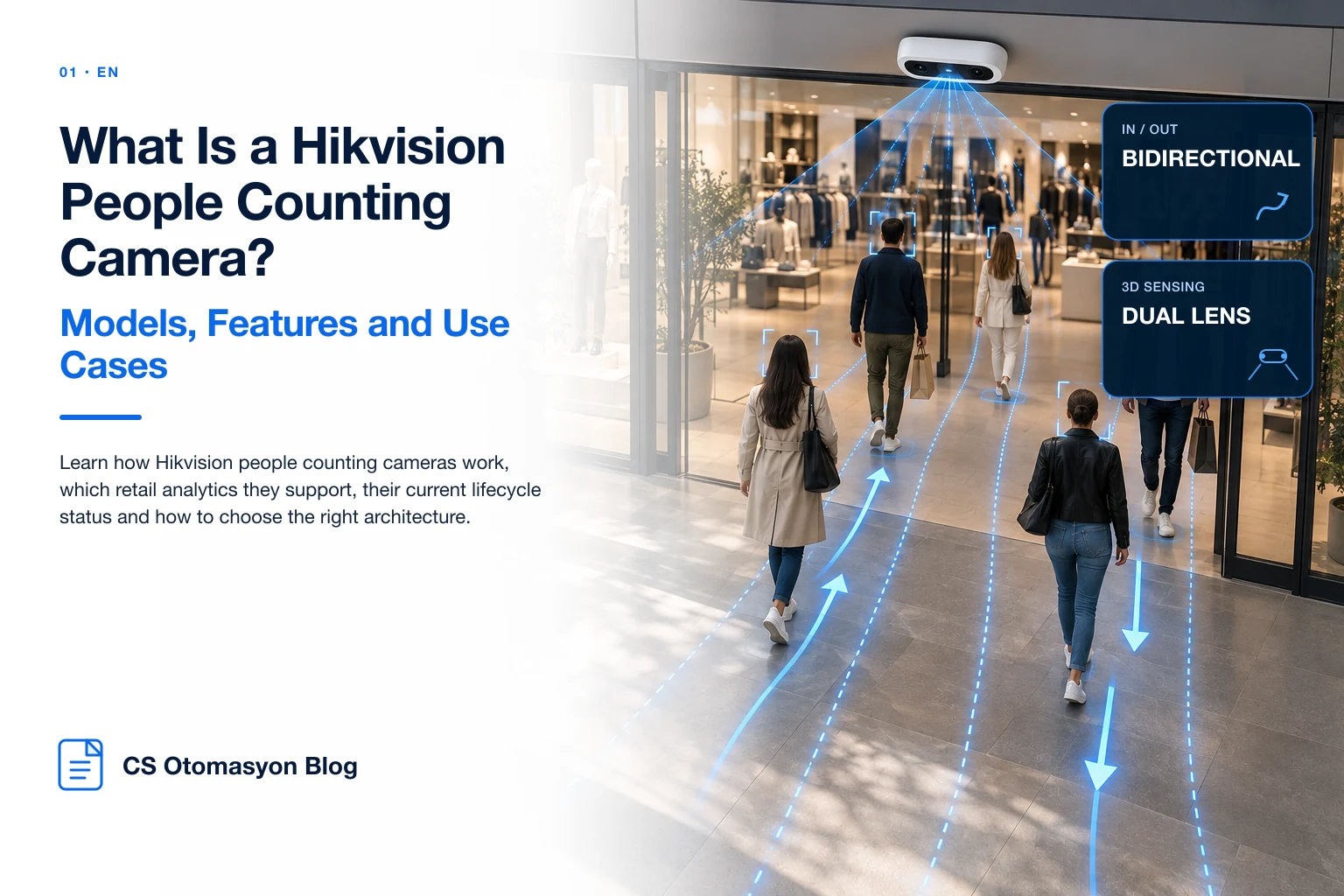
What Is a Hikvision People Counting Camera? Models, Features and Use Cases
Search intent and context
Within the Hikvision ecosystem, people counting can sit alongside heat mapping, pathway analysis and queue analytics, so megapixel count alone is not a valid selection criterion.
Technology and analytics capabilities
Dual-lens people counting uses depth cues from two views to separate people from the background and improve directional entry/exit classification.
Limitations and field criteria
CS Otomasyon lists the DS-2CD6825G0/C-IS family, while Hikvision’s current retail page marks the DS-2CD6825G0/C-IV(S) family as EOL. Lifecycle should therefore be checked for new rollouts.
Procurement / integration decision
Retail entrances, showrooms, branch networks and queue zones are common use cases. Final selection should be validated through site survey, pilot deployment and manual reference counts.
Why a people-counting camera is more than “just a camera”
The same device can perform very differently across two retail entrances. Mounting angle, the number of pixels occupied by a person, ceiling geometry, door movement and short bursts of congestion all affect the analytics. For that reason, a people-counting camera should not be selected like a conventional security camera using resolution, lens and night-vision specifications alone.
When footfall feeds a conversion-rate KPI, count quality becomes financially material. A small systematic error repeated across hundreds of stores can distort store rankings and operational decisions. Installation standards, manual reference counts and recurring data-quality checks therefore matter as much as the device itself.
Designing data architecture for a store network
At a single site, reading a daily count from the device interface may be enough. Across dozens or hundreds of branches, store ID, device ID, time zone, opening hours, entrance name and missing-data flags must be standardized. Otherwise even a single-vendor estate can produce data that is difficult to compare centrally.
A stronger architecture sends normalized traffic metrics into a central layer where dashboards, POS and staffing data can be joined. Hardware can then change without redefining “visitor”, “walk-in”, “occupancy” or “conversion”. This is where a systems integrator creates durable value: turning the counter into a reliable data source and the data source into an operational KPI.
Common field conditions that damage accuracy
Test side-by-side visitors, children and strollers, shopping trolleys, greeters near the doorway, visitors who enter and immediately turn back, people lingering outside and dense overlapping trajectories. Good performance during a quiet ten-minute test does not prove performance during peak retail traffic.
Lighting and merchandising also change. Seasonal signage, hanging promotional material or new security gates can partially obstruct the field of view months after commissioning. Installation photos, counting lines and calibration parameters should therefore be documented and revisited after layout changes.
Connecting footfall to store operations
Entrance counts are only the first layer. Join them with transactions to calculate conversion, with shifts to understand staffing pressure, and with queues to identify service bottlenecks. Heat or pathway analytics can add in-store context when the business question requires it.
The key is not to mistake correlation for causation. High traffic with low conversion does not automatically mean poor staffing; assortment, campaign quality, stock availability, weather or location mix may be involved. Reliable footfall data helps teams ask a better question, but it is rarely the entire answer.
The CS Otomasyon approach
CS Otomasyon does not start with a logo or megapixel count. The process starts with entrance geometry and the business KPI, then selects a camera or 3D counter that fits the site. Manual reference testing, data-continuity checks and central reporting are treated as one acceptance package.
FAQ
Is a people counter different from a normal CCTV camera?
Yes. Counting needs a suitable view geometry, mounting position and analytics configuration.
Can an EOL model still be used?
Installed systems may continue working, but new procurement should consider support, availability and current alternatives.
Why validate during peak traffic?
Occlusion and side-by-side movement increase under peak load, revealing errors that may not appear in a quiet test.
How often should count quality be checked?
For critical KPIs, combine automated health monitoring with periodic manual samples and revalidation after layout changes.
Can a chain use different sensors?
Yes. Different hardware can feed one dashboard when the common data model and acceptance criteria remain consistent.
Conclusion and CTA
Choose the technology against the real entrance geometry and target KPI rather than the logo on the device. A site survey and controlled pilot with CS Otomasyon can validate the architecture before rollout and connect the resulting data to centralized reporting.