
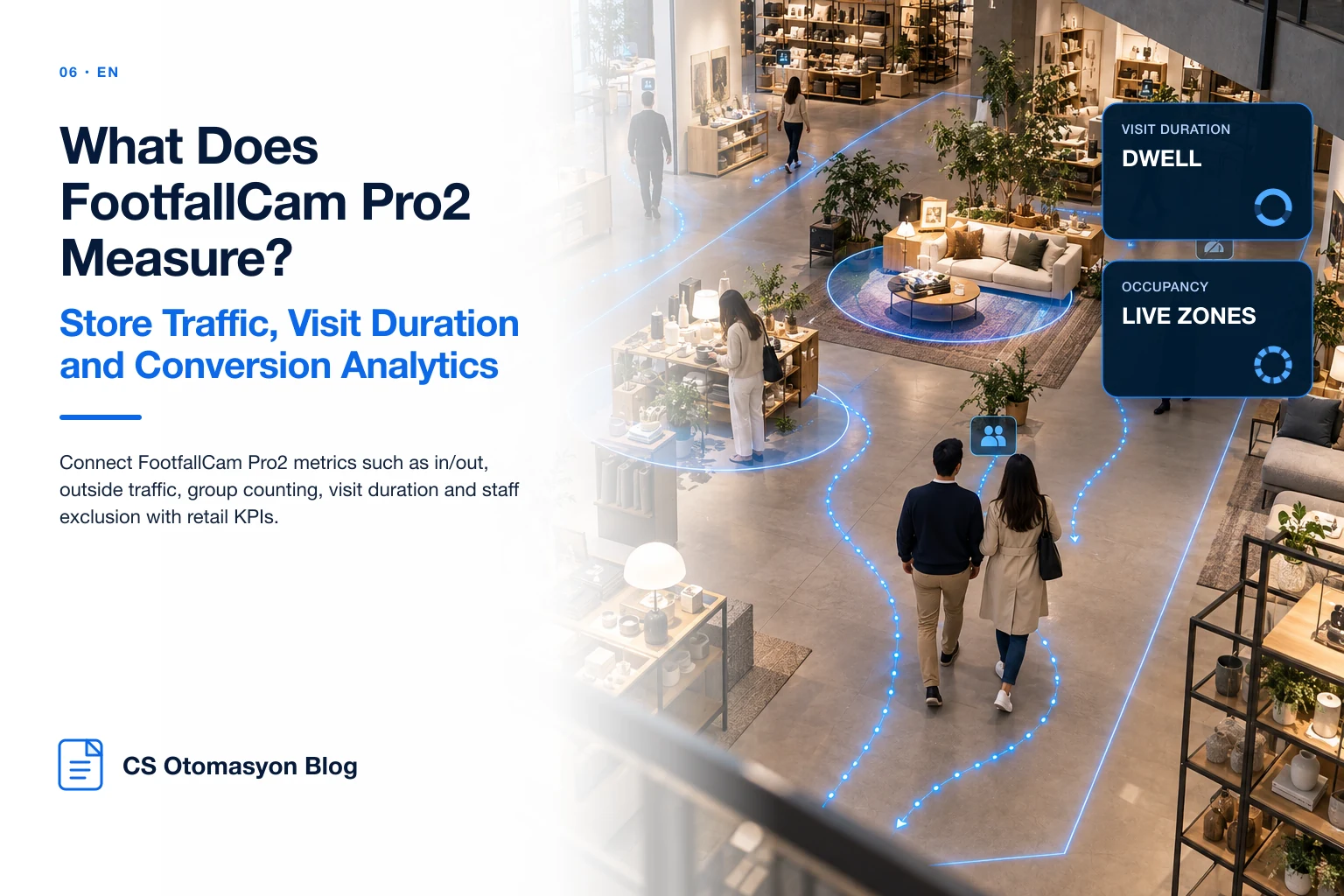
What Does FootfallCam Pro2 Measure? Store Traffic, Visit Duration and Conversion Analytics
Overview and context
Pro2’s current framework defines six operational metrics covering traffic, behaviour and engagement.
Technology and analytics capabilities
When in/out data is aligned with POS transactions for the same period, it can support store conversion analysis and separate traffic issues from sales-execution issues.
Limitations and field criteria
Outside traffic plus walk-ins can support storefront capture-rate analysis.
Procurement / integration decision
Visit duration estimates time spent in the store, while staff exclusion aims to remove employee movement from customer traffic.
Why putting six metrics on one dashboard is not enough
In/out, outside traffic, groups, visit duration, demographic estimates and staff exclusion answer different business questions. Showing every metric at once can create a sophisticated-looking dashboard that does not support a specific decision.
For sales conversion, clean customer footfall and transactions may be enough. Storefront analysis needs outside traffic, workforce filtering needs staff exclusion, and experience analysis may use visit duration.
How visit duration can be misread
Long visits do not always indicate strong engagement. Large store formats, checkout queues, difficulty finding products or service delays can all increase visit duration. The metric needs sales, queue and format context.
Likewise, short visits are not automatically poor experiences; click-and-collect customers or mission shoppers may intentionally spend very little time in store.
Why staff exclusion matters for conversion
Employees crossing an entrance repeatedly can materially inflate footfall in smaller stores. A larger denominator then pushes calculated conversion down and can distort comparisons between branches with different staffing patterns.
The exclusion method itself should be validated. Whether it relies on tags, behaviour, appearance cues or another technique, teams should measure both missed staff and accidental customer exclusions.
Connecting metrics to decision cadence
Real-time metrics should support in-shift action, daily and weekly metrics should support trend management, and monthly metrics should inform location or format strategy. Not every number belongs in every reporting cadence.
A useful platform gives store managers operational signals, headquarters benchmarking and technical teams device-health visibility from the same underlying measurement system.
The CS Otomasyon approach
With metric-rich devices such as Pro2, CS Otomasyon starts from the business question and exposes only measurements that support decisions. Data-quality signals, staff-exclusion validation and POS time alignment are part of KPI design.
FAQ
Is visit duration the same as dwell time?
They are closely related; this metric links entry and exit trajectories to estimate visit length.
Does every store need outside traffic?
No. It is most valuable when storefront or location capture is a key question.
Why can group counting matter?
Visitors moving together can behave like one buying unit in some retail formats, so the metric can add context.
Are demographic estimates required for retail KPIs?
No. If the business question does not need them, clean footfall and conversion may be more appropriate.
Does more metrics automatically mean more accuracy?
No. Each metric needs its own definition and validation; additional metrics increase data-governance requirements.
Conclusion
Choose the technology against the real entrance geometry and target KPI rather than the logo on the device. A site survey and controlled pilot with CS Otomasyon can validate the architecture before rollout and connect the resulting data to centralized reporting.