
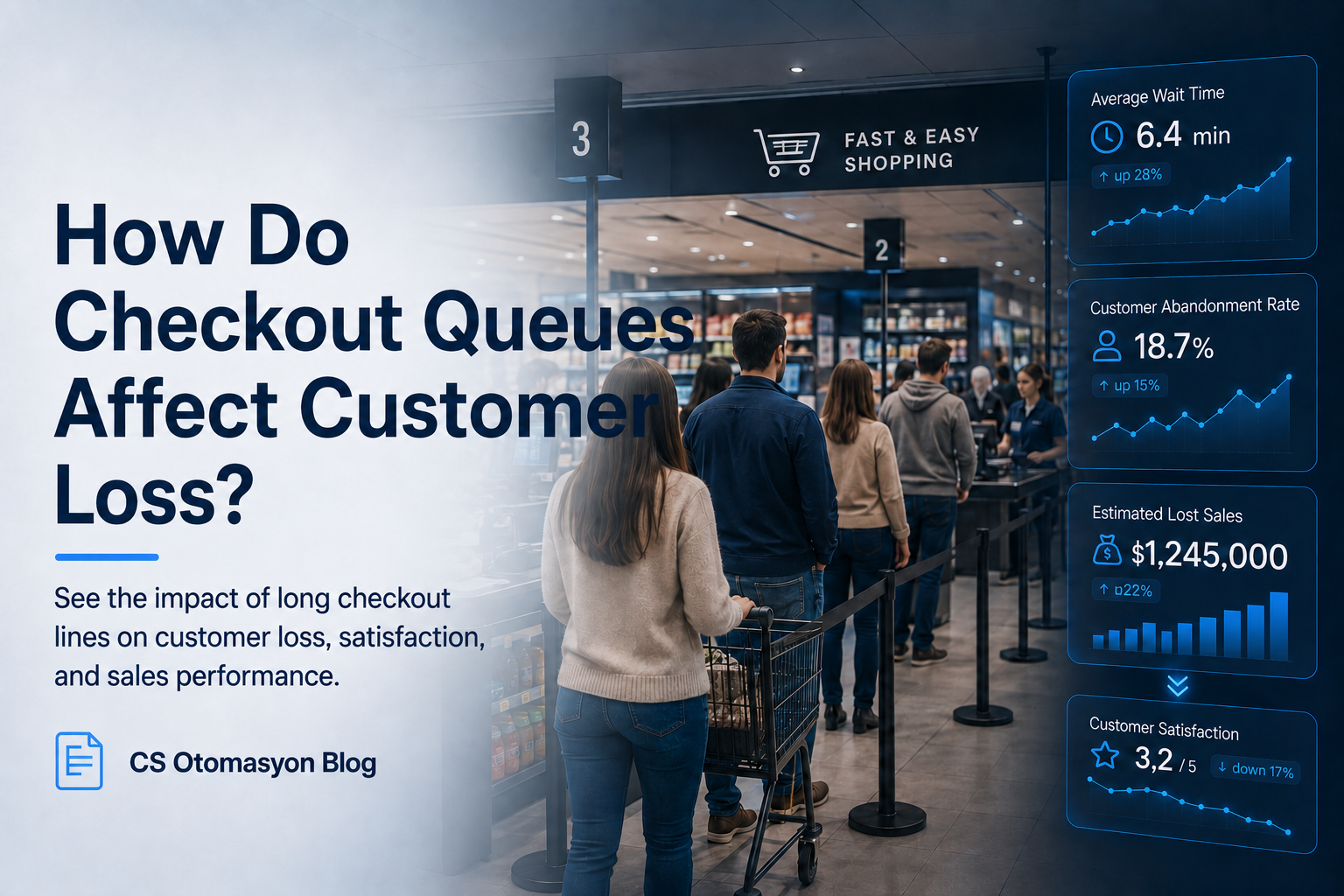
Managing Checkout Queues and Waiting Times
The Operational Impact of Checkout Queues and Waiting Times
The final point of the shopping journey inside a store is the payment step. No matter how satisfying the aisle layout and product quality are, prolonged checkout queues can cause the customer experience to be perceived negatively. Monitoring checkout density in operational management is a noteworthy element for both customer satisfaction and preventing sales losses.
Waiting Times and Customer Tendencies
Consumers' tolerance for waiting in physical environments is gradually decreasing. Checkout queues that exceed a certain timeframe can increase the feeling of congestion inside. For their next shopping decision, the perception that "there is a long wait at the checkout" can become one of the indirect factors influencing store preference.
Abandoning the Purchase (Cart Abandonment)
One of the most concrete consequences of checkout bottlenecks is when a customer, having chosen a product, sees the queue and decides to give up waiting, leaving the items behind. This not only drops potential immediate revenue but also creates extra workload for store employees who must restock abandoned items.
Visitor Traffic and Staff Planning
One way to reduce density problems is to act based on data rather than traditional estimates. By examining the store's overall traffic hours, it can be planned which days and time slots require backup registers or additional staff. With regular analysis, operations become predictable rather than reactive.
Approaches to Checkout Density Analysis
Wait times (dwell time) in front of checkouts can be monitored with analytical systems positioned in specific areas. In advanced analytics projects, scenarios can be configured to send information (generate alerts) to the operations team when predefined density or wait thresholds are exceeded.
Support Your Operations with Data
You can explore CS Otomasyon's analytical approaches to understand density trends in checkout areas and improve your in-store analysis processes.
Frequently Asked Questions
How does it distinguish between those waiting and those just standing?
Systems can be configured to include people who remain stationary/slow for a certain duration (e.g., 1-2 minutes) within the defined area in the analysis.
Is queue analysis suitable for all retail sectors?
It is especially preferred in high-circulation places like FMCG (supermarkets), home improvement stores, and clothing stores during sales periods.
How are managers informed of the real-time situation?
Alerts can be transmitted to designated teams via notification systems configured on a project basis.
Does visitor traffic data support queue analysis?
Absolutely; seeing a sudden traffic spike at the entrance is often an indicator of potential density at the checkout a few minutes later.
Can sales losses be completely prevented?
The primary purpose of the system is to report the current trend to management; swift actions taken using the obtained data help minimize losses.
Explore CS Otomasyon people counting solutions or read more articles.