
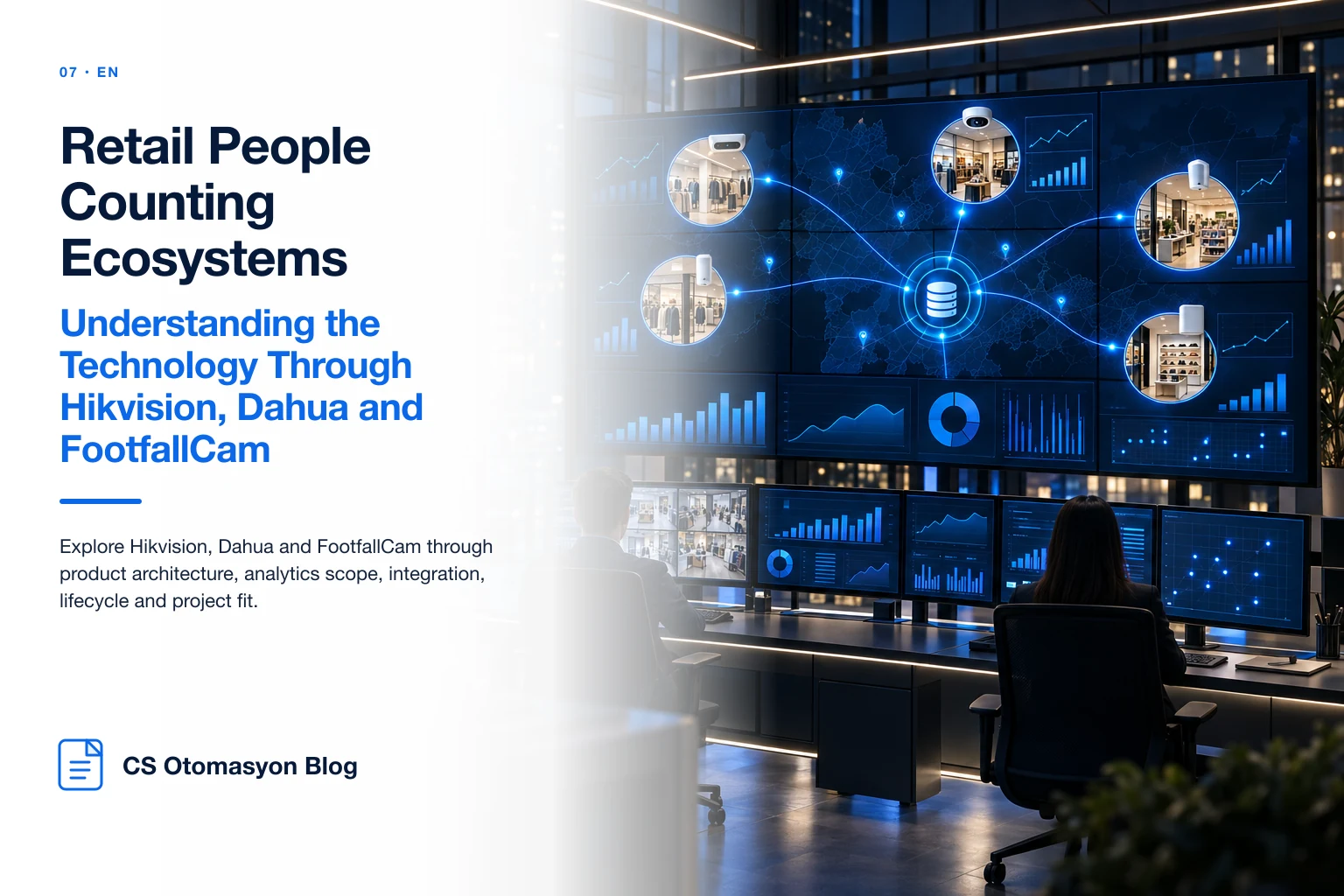
Retail People Counting Ecosystems: Understanding the Technology Through Hikvision, Dahua and FootfallCam
Overview and context
Hikvision, Dahua and FootfallCam represent different product ecosystems, but organizations often share the same underlying need: converting physical visitor traffic into reliable operational data.
Technology and analytics capabilities
Camera ecosystems may emphasize sensing inside a broader security stack, while a dedicated footfall platform emphasizes entrance intelligence and retail metrics. These are product philosophies, not a winner-and-loser ranking.
Limitations and field criteria
Enterprise projects still share the same questions around data ownership, APIs, store identity, time synchronization, fleet health and accuracy validation.
Procurement / integration decision
The CS Otomasyon objective is to preserve useful existing infrastructure while creating the required measurement quality and a consistent central KPI standard.
How camera analytics and dedicated footfall platforms meet in the same market
Retail people counting is not one product category. Video ecosystems such as Hikvision and Dahua position counting inside camera and VMS stacks, while a vendor such as FootfallCam packages sensing together with retail metrics and a footfall platform. Despite these differences, the underlying problem is often the same: turning physical traffic into reliable data.
The useful comparison is therefore not “who wins?” but which layers exist in each ecosystem: sensing, edge analytics, data export, centralized reporting and business KPI.
How different procurement needs diverge
Some organizations want to reuse an existing CCTV estate, others need a dedicated counter, and others need a platform for hundreds of branches. These requirements lead to different procurement and integration approaches.
A sound evaluation should address existing infrastructure, new hardware, integration, licensing, data ownership, field accuracy and support. This keeps the decision focused on system requirements rather than brand familiarity.
Why a hardware-independent data model is strategic
Using one sensor at every location is not always practical. Ceiling height, outdoor exposure, legacy sites and procurement cycles often create mixed fleets. If the KPI layer depends on one model, every hardware change becomes a reporting project.
A common data contract normalizes entry, exit, occupancy, queue and dwell. Adding a new sensor then changes an adapter rather than the business dashboard.
The value of a vendor-neutral assessment
Ranking vendors with decontextualized accuracy percentages may look compelling, but claims, firmware and field conditions change quickly. Such comparisons age badly and can feel commercially biased.
Using official terminology accurately, keeping lifecycle information current and addressing real field questions supports better technical decisions. CS Otomasyon therefore evaluates each ecosystem through engineering criteria rather than brand visibility.
The CS Otomasyon approach
The CS Otomasyon position is ecosystem orchestration rather than vendor ranking. Camera analytics, dedicated footfall and central retail-platform layers are combined around the customer's existing infrastructure and normalized into a common KPI vocabulary.
FAQ
Can all three feed one dashboard?
Potentially yes if supported interfaces can be normalized into a common data model.
Is the vendor with most features automatically best?
No. Field accuracy and integration usually matter more than unused features.
Does evaluating a named vendor automatically make the comparison biased?
No. A sound comparison can use verified product functions and official technical information; partnership or superiority claims require evidence.
Is a multi-vendor estate a problem?
It can be managed with sound adapters and health monitoring, and site diversity may require it.
Why should vendor assessments be read alongside technology guides?
Vendor and model information leads to better decisions when considered together with sensing method, site geometry, data integration and KPI goals.
Conclusion
Choose the technology against the real entrance geometry and target KPI rather than the logo on the device. A site survey and controlled pilot with CS Otomasyon can validate the architecture before rollout and connect the resulting data to centralized reporting.