
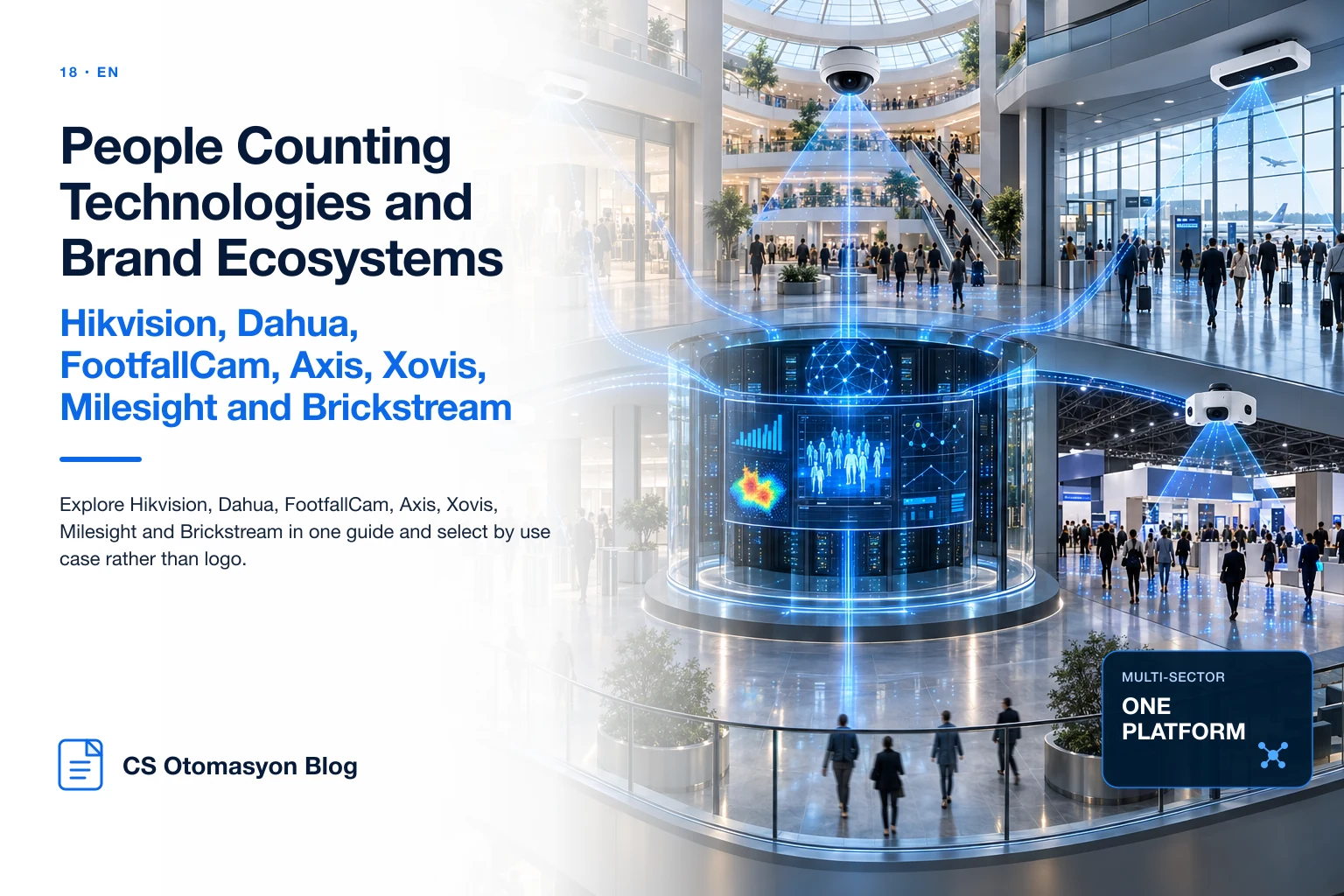
People Counting Technologies and Brand Ecosystems: Hikvision, Dahua, FootfallCam, Axis, Xovis, Milesight and Brickstream
Overview and context
The people-counting market spans camera vendors, dedicated 3D-sensor makers and retail analytics platforms, so the same label can represent very different architectures.
Technology and analytics capabilities
Hikvision, Dahua and Axis come from broad camera ecosystems; Xovis, Milesight and Brickstream emphasize dedicated 3D/people-flow sensing; FootfallCam emphasizes a retail-footfall platform model.
Limitations and field criteria
Selection should center on site geometry, KPI, integration, data model, product lifecycle and TCO.
Procurement / integration decision
CS Otomasyon selects the appropriate sensor for each site and normalizes the resulting data under common reporting and validation standards.
Why the people-counting market contains brands from different origins
Some vendors come from video security, others from dedicated 3D sensing, and others from retail analytics and footfall software. The same people-counting need can therefore involve cameras, depth sensors, edge applications, cloud platforms and BI products.
That diversity is useful because different physical spaces and business objectives require different sensing architectures. The market should be assessed by the problem each ecosystem solves rather than through a brand ranking.
What camera ecosystems address
Camera-led ecosystems such as Hikvision, Dahua and Axis can combine security video, AI events and selected counting or occupancy functions on a shared network stack. That context matters for organizations with an existing VMS standard.
Not every camera in a brand family supports the same footfall function, so exact model, firmware, view geometry and analytics scenario must be verified.
What dedicated 3D sensing ecosystems address
Xovis, selected Milesight families and Brickstream place depth and overhead geometry at the centre of people-flow measurement. Different variants exist for standard entrances, high ceilings, wide areas and privacy-led projects because the sensing geometry changes.
Dedicated sensing can create repeatable installation standards, but field acceptance testing is still required regardless of brand.
What a retail-footfall platform adds
A platform-led vendor such as FootfallCam places outside traffic, group metrics, visit duration, staff exclusion and fleet analytics beside the entrance count. The measurement vocabulary and retail KPI workflow become part of the product.
Enterprise buyers should therefore examine data ownership, APIs, licensing, retention and fleet health as carefully as the hardware specification.
How to assess brand ecosystems together
Each vendor should be assessed through sensing method, target geometry, data output and integration approach. Milesight addresses ToF and stereo options, Xovis covers high-mount classes, and camera vendors such as Hikvision and Dahua provide broader camera and AI-analytics ecosystems.
This comparison moves beyond device names and clarifies the relationship between technology, integration and solution design.
The CS Otomasyon assessment approach
Instead of naming a “best brand”, the assessment should explain which problem class each ecosystem addresses, what must be measured on site and which enterprise integration questions matter.
Long-term technical confidence comes from current lifecycle information, verified claims and real field knowledge—not from repeating brand names.
The CS Otomasyon approach
CS Otomasyon does not rank vendors or name a universal winner. Each ecosystem is assessed through sensing, site design, data output, lifecycle and integration so the technology can be matched to real project requirements.
FAQ
What is the best brand?
There is no universal answer; the right choice depends on the use case.
Can one project use multiple brands?
Yes, if data is normalized into a common platform.
Should product pricing be part of this assessment?
Pricing matters, but it should be evaluated together with technology, integration and total cost of ownership in a dedicated buying assessment.
How often should the brand list be reviewed?
Review it when major EOL events, new product families or platform changes occur.
Can new brands be added to the assessment?
Yes. The scope can expand when verified product knowledge, real field experience and a meaningful use case are available.
Conclusion
Choose the technology against the real entrance geometry and target KPI rather than the logo on the device. A site survey and controlled pilot with CS Otomasyon can validate the architecture before rollout and connect the resulting data to centralized reporting.