
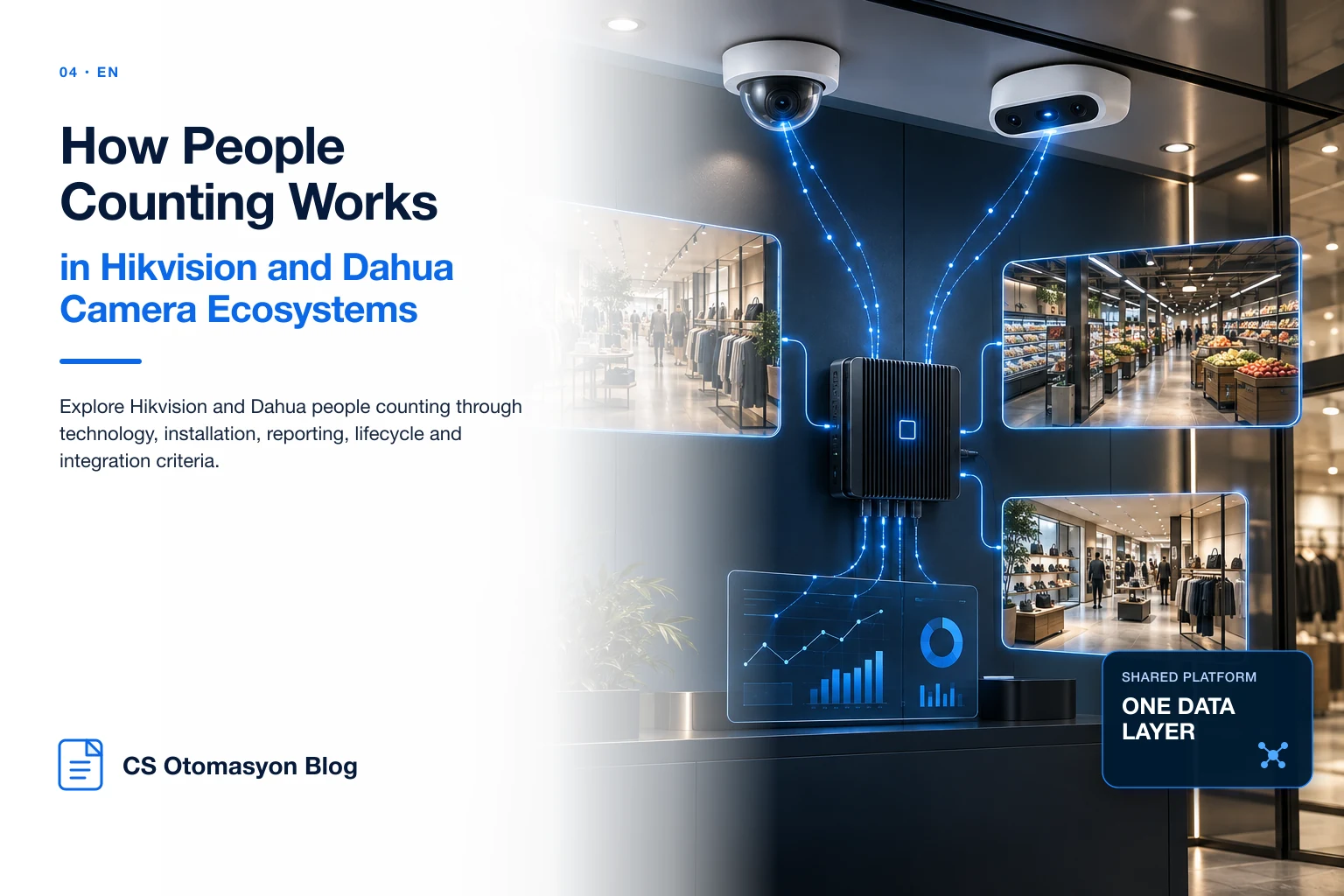
How People Counting Works in Hikvision and Dahua Camera Ecosystems
Overview and context
Hikvision and Dahua both position people counting inside broad camera and video-analytics ecosystems. In each ecosystem, counting should be evaluated across sensing, edge AI, reporting and field installation rather than by brand name alone.
Technology and analytics capabilities
A family label alone is not enough in either ecosystem. Exact model and firmware support for people counting, queue, crowd or other retail analytics should be verified.
Limitations and field criteria
Site geometry, mounting height, entrance width, lighting and density directly affect analytics performance. Even two products from one vendor may target different physical conditions.
Procurement / integration decision
Enterprise decisions should consider the existing VMS estate, data/API requirements, lifecycle, field acceptance and central KPI architecture together.
Where people counting sits inside broad camera ecosystems
In vendors such as Hikvision and Dahua, people counting is part of a broader video-analytics portfolio rather than an isolated category. Security cameras, edge AI, VMS/NVR, counting, heat, queue and crowd functions can therefore serve different operational needs within one enterprise.
Understanding how large camera ecosystems productize footfall helps teams design the right architecture. Dedicated counters, general AI cameras and central reporting can coexist within the same organization.
Read the analytics function, not just the family name
Labels such as “AI camera”, “DeepinView” or “WizMind” do not mean every model supports the same people-counting rules. Procurement and integration should verify the exact model, firmware and supported analytics scenario.
The practical distinction is between real functions and model-level capabilities. Brand names alone do not establish whether a device fits the required counting scenario.
Common requirements at the reporting layer
Regardless of camera brand, an enterprise asks the same questions: What is the reporting interval? Can historical data be exported? What happens during a network interruption? Is there an API or event interface? Can store and entrance IDs be standardized centrally?
Those questions outlive a particular SKU. If the KPI definition and data contract remain stable, hardware can evolve without breaking the dashboard.
A vendor-neutral site-survey checklist
Measure entrance width, ceiling height, indoor/outdoor exposure, reflections, door type, flow direction, security gates, peak density and cabling options before selecting a model.
Choosing the logo first forces the site to fit the product. A more durable systems approach starts with the business measurement, then the physical site, and only then the sensor or camera.
The CS Otomasyon approach
CS Otomasyon does not turn the two camera ecosystems into a vendor scorecard. Both are evaluated using the same engineering questions: geometry, supported analytics, data output, lifecycle and pilot accuracy. The objective is a sound measurement standard, not a brand contest.
FAQ
Which brand is more accurate?
There is no universal brand-level answer; model and installation determine performance.
Is a pilot necessary?
It is strongly recommended before a multi-site rollout.
Does every AI camera in a brand support people counting?
No. Exact model and firmware capabilities must be verified.
Does an existing VMS standard influence selection?
It can simplify integration and operations, while field accuracy still requires separate validation.
How can vendor-neutral acceptance criteria be written?
Define mounting range, error tolerance, data output, network behaviour and the manual reference method.
Conclusion
Choose the technology against the real entrance geometry and target KPI rather than the logo on the device. A site survey and controlled pilot with CS Otomasyon can validate the architecture before rollout and connect the resulting data to centralized reporting.