
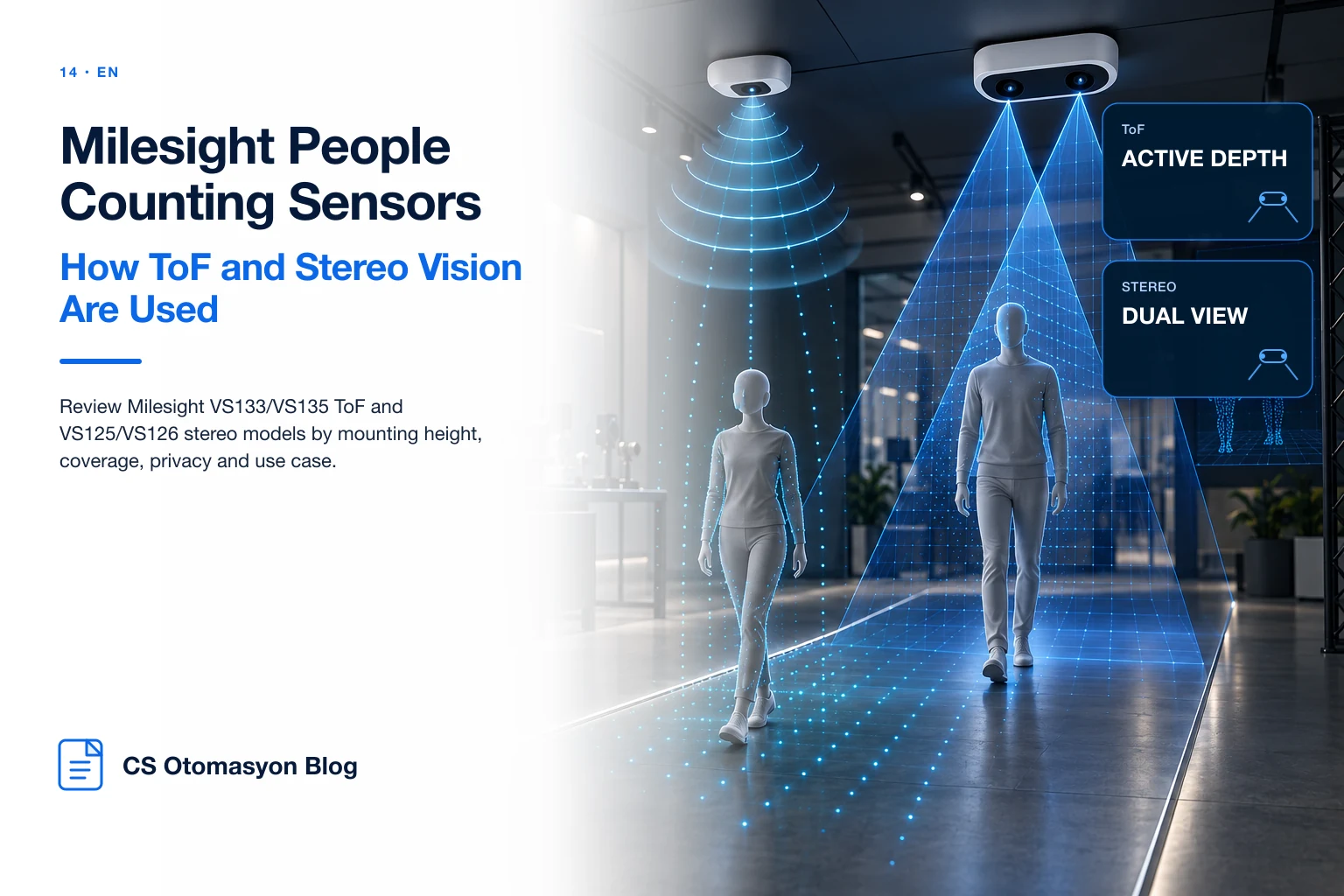
Milesight People Counting Sensors: How ToF and Stereo Vision Are Used
Overview and context
Milesight offers ToF and binocular-stereo products in the same people-counting portfolio. The two approaches address different site geometries and mounting conditions.
Technology and analytics capabilities
VS133/VS135 use ToF depth sensing, VS125 uses binocular stereo vision, and VS126 is positioned for ultra-high mounting.
Limitations and field criteria
Selection should consider mounting height, coverage, lighting, privacy, indoor/outdoor class and the required metrics.
Procurement / integration decision
Published accuracy claims should be sourced and never treated as a substitute for field acceptance testing.
What it means when one vendor uses two sensing approaches
Milesight’s current people-counting portfolio includes ToF-based VS133/VS135 products alongside binocular stereo devices such as VS125 and the high-mount VS126. That portfolio itself shows there is no single sensing method for every physical environment.
The useful comparison is not a model scorecard, but an assessment of which site parameters affect ToF and stereo. Product selection should follow real installation conditions rather than model familiarity.
What to inspect in a ToF deployment
Because ToF uses active depth sensing, mounting height, field of view, strong light and reflective surfaces can matter. Depth-oriented processing may support privacy-led designs, but actual data flows and retention should still be verified from the model documentation.
Coverage should be calculated against entrance width with operating margin rather than treating a catalogue maximum as a guaranteed design point.
What to inspect in a stereo-vision deployment
Stereo vision derives depth from two images, so both views must remain clear and the scene must support stable matching. Milesight positions VS125 around binocular AI with regional counting and dwell, while VS126 targets ultra-high mounting from 6 to 15 metres.
In wide or high spaces, tracking continuity and multi-device design become as important as raw coverage.
How to read a vendor accuracy claim
Milesight currently publishes “up to 99.8%” for selected products. “Up to” describes performance under appropriate conditions; it is not an automatic guarantee for every entrance.
The validation method matters more than repeating the headline percentage as a promise.
The CS Otomasyon approach
CS Otomasyon does not turn Milesight ToF and stereo into a catalogue contest. Entrance width, height, lighting, privacy, coverage and network needs determine the product class, and vendor accuracy claims are validated in the field.
FAQ
Do VS133 and VS125 use the same technology?
No. VS133 uses ToF and VS125 uses stereo vision.
Which model class targets high ceilings?
VS126 is designed for ultra-high mounting.
Why is VS126 a separate high-mount product?
Milesight positions it for 6-15 m mounting, with optics and coverage designed around that geometry.
Can strong sunlight affect ToF?
Strong light can matter for active depth sensing; outdoor or transition suitability should be checked per model.
How should an “up to” accuracy figure be written?
Treat it as the manufacturer’s upper-performance claim, not a field guarantee.
Conclusion
Choose the technology against the real entrance geometry and target KPI rather than the logo on the device. A site survey and controlled pilot with CS Otomasyon can validate the architecture before rollout and connect the resulting data to centralized reporting.