
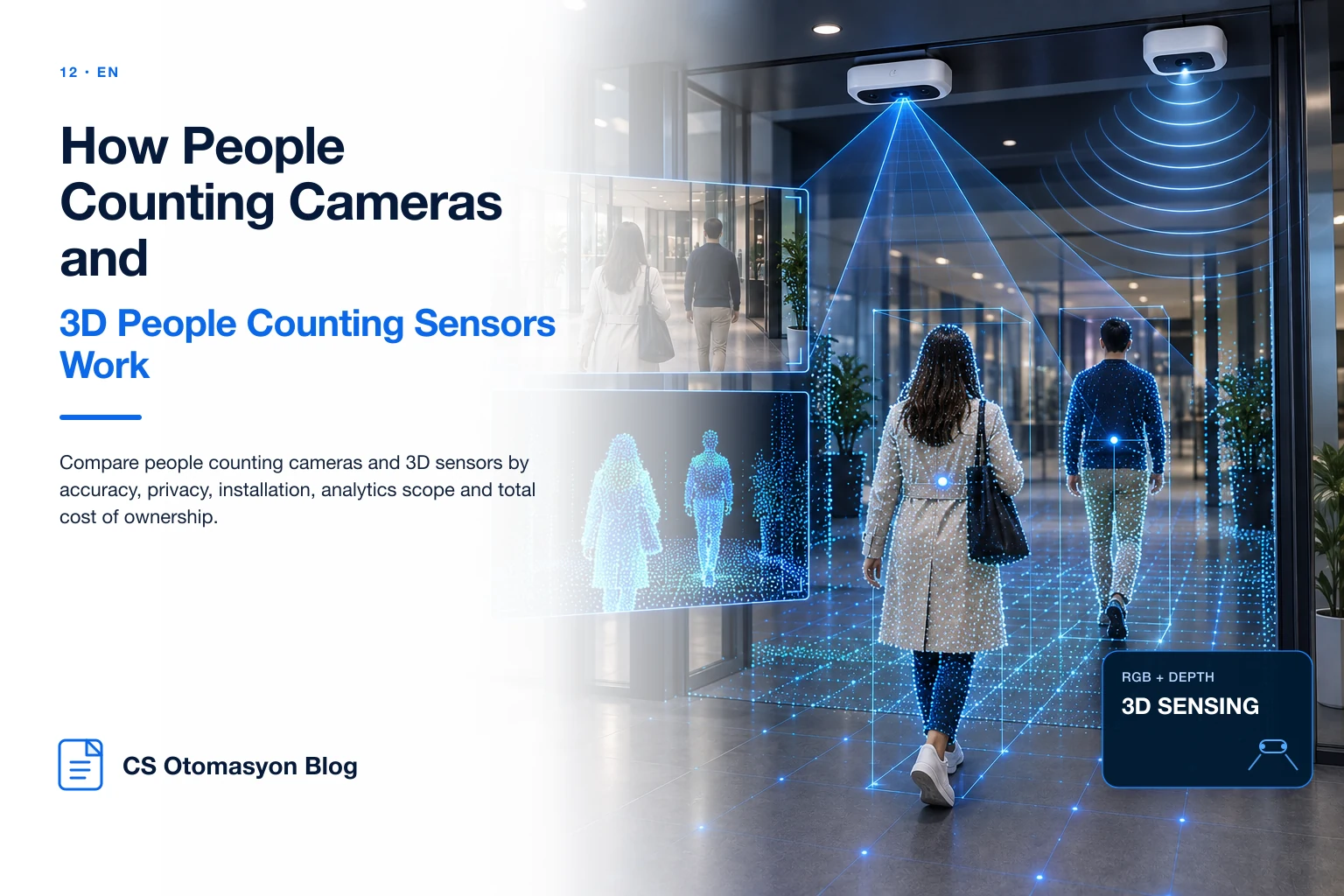
How People Counting Cameras and 3D People Counting Sensors Work
Overview and context
People-counting cameras and 3D sensors are often discussed together. The goal is not to name one “better” category, but to understand which physical signals different sensing approaches use to produce counts.
Technology and analytics capabilities
Single-lens analytics relies on RGB video, stereo vision derives depth from two views, and ToF uses active ranging. Product classes can also differ in edge processing, zone analytics and privacy behaviour.
Limitations and field criteria
Field success depends as much on mounting height, occlusion, entrance width, density and calibration as on the sensing method.
Procurement / integration decision
Enterprises can use different sensing methods across locations as long as they connect to a common data model and acceptance standard.
What physical information do 2D video, stereo vision and ToF use?
Single-lens video analytics infer people from RGB appearance and motion. Stereo vision derives depth from disparity between two views. ToF estimates distance using the travel time of active light. All can support counting, but the underlying physical signal is different.
That distinction matters under difficult conditions such as shadows, low light, high ceilings, similar clothing or dense side-by-side movement.
Privacy architecture should be designed with the sensing method
RGB video can support richer visual analytics but also requires clear policies for image access, recording and retention. Depth-oriented sensors may reduce identity exposure, although teams still need to confirm what the device stores and which integrations are enabled.
Privacy compliance is not created by an “anonymous sensor” label alone; purpose limitation, user access, retention, logging and data transfer remain architectural requirements.
Installation standards can matter more than sensing technology
An advanced 3D counter can fail when mounted outside its intended range or partially obstructed. A simpler video approach can be adequate when geometry is good and the business tolerance is less strict.
Technical specifications should therefore define installation range, acceptance testing and recalibration procedures in addition to the device feature list.
Multiple sensing approaches can coexist
An enterprise may use an outdoor camera at a high-street entrance, a ToF or stereo counter at standard retail doors, a high-mount 3D sensor in an atrium and centralized AI on existing CCTV.
The systems task is to normalize those sources into one KPI vocabulary rather than forcing every site onto identical hardware.
The CS Otomasyon approach
CS Otomasyon selects technology based on sensing physics, site geometry, privacy requirements and KPI tolerance rather than a camera-versus-sensor label. Multiple sensing approaches can coexist under one enterprise dashboard.
FAQ
Is a 3D sensor always more accurate?
No. Product choice and installation quality remain decisive.
ToF or stereo?
It depends on lighting, ceiling height, entrance width and site geometry.
Must a depth sensor record video?
No. Some devices can operate on depth and derived metrics; verify the actual model behaviour.
Can a 3D sensor produce heat-style analytics?
Some products support zones, dwell or heat-like outputs; capability is model-specific.
Is it wrong to use both ToF and stereo in one enterprise?
No. Both can coexist when a common KPI and integration standard is maintained.
Conclusion
Choose the technology against the real entrance geometry and target KPI rather than the logo on the device. A site survey and controlled pilot with CS Otomasyon can validate the architecture before rollout and connect the resulting data to centralized reporting.