
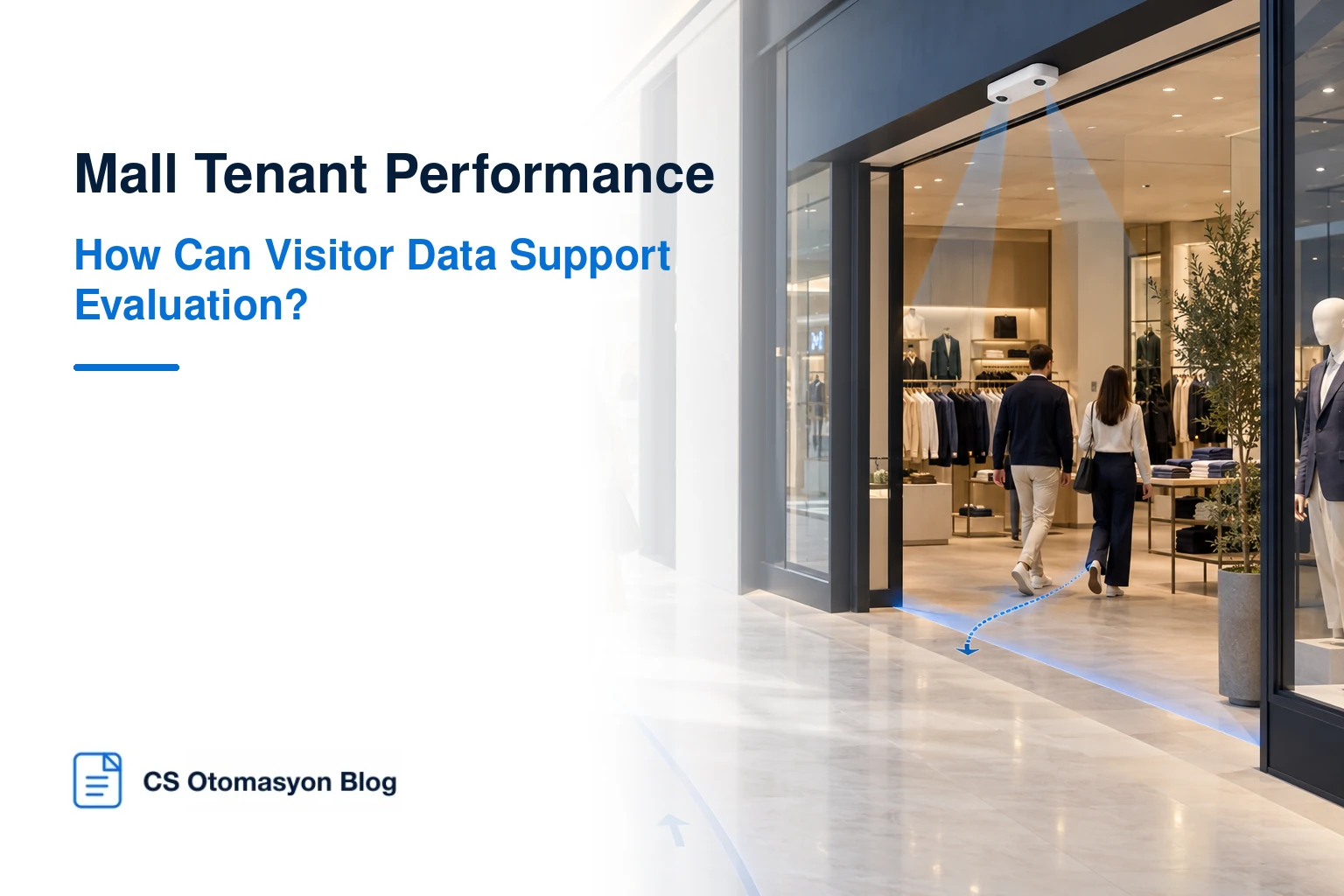
How Can Visitor Data Help Evaluate Shopping Mall Tenant Performance?
An increase in a mall’s total visitor count does not mean that more customers entered every tenant’s store. Which entrance people use, which floor they explore and which store they enter are separate measurement questions. Keeping these distinctions clear helps avoid misleading tenant performance comparisons.
Shopping mall people counting systems can measure overall entrance, floor and corridor flows. To obtain a tenant’s actual store entry count, an appropriate measurement is also needed at that store’s entrance. Presenting mall-level data as store-level data is an analytical error.
Three levels of traffic in tenant performance
Overall mall traffic is the total number of crossings through the mall’s measured entrances. Location traffic shows movement in the corridor or nearby passage area where the store is located. Store entry traffic counts people crossing the entry line of that tenant’s store.
Suppose 10,000 corridor crossings and 1,200 store entries are measured in a day. Their ratio may provide an approximate indicator of how much passing traffic enters the store, but only if the measurement area, direction, repeat crossings and time window are appropriately defined. It is not a direct measure of conversion among actual unique visitors.
From traffic to sales: What does a conversion rate require?
In practice, a store’s transaction-based conversion rate can be tracked by dividing the number of valid POS transactions, using a definition fixed in advance, by the number of store entries. For example, 100 valid sales receipts and 1,000 entries give a transaction-based conversion rate of 10%. This does not mean that “exactly one in every 10 people made a purchase”: one person may make several transactions, a family may share a receipt, staff entries may be counted, or returns may be included.
More reliable commercial analysis requires defined POS transaction types, store opening hours, staff exclusion methods and data privacy conditions. The integration steps are covered in our guide to people counting data and POS systems.
A checklist for fair tenant comparisons
- Comparison factor: Similar store category
Why it matters: Visitor behaviour differs between grocery, fashion and service stores - Comparison factor: Measurement period
Why it matters: Hours, holidays, seasons and campaign periods must match - Comparison factor: Entry definition
Why it matters: Treatment of staff and repeat crossings must be comparable - Comparison factor: Location
Why it matters: Corner stores, corridor-end stores and stores near an anchor receive different traffic - Comparison factor: POS access
Why it matters: Sales data underpins commercial conversion analysis - Comparison factor: Data integrity
Why it matters: Missing hours and sensor faults must not appear as declining performance
Corridor movement around anchor stores is particularly relevant to tenant analysis. However, inferring purchase decisions or specific individuals’ visit paths from that movement requires additional data. Our article on anchor store traffic and mall performance explains how location effects can be considered.
Define permissions and scope before sharing data
Mall management may share common-area traffic reports with tenants, but store-level measurements and POS results often contain commercial data belonging to different parties. Which reports may be shared, with whom, at what level of detail and how often should be defined within contractual, authorisation and data protection requirements. Competitively sensitive sales information must not be added to shared reports without permission.
Conclusion
A sound evaluation of tenant performance keeps mall traffic, movement outside stores and store entry counts separate. Suitable POS data is essential when interpreting conversion. CS Otomasyon can help you assess measurement points and reporting permissions together to build meaningful comparisons for leasing and retail teams.