
Xovis People Counting Sensors: PC2SE, PC3SE and High-Ceiling Applications
Overview and context
Xovis PC-Series is a 3D-sensor portfolio for people counting and in-store analytics across a broad range of mounting heights.
Technology and analytics capabilities
The 2025 selection guide places the standard PC2 series around 2.20-6.00 m, with specialized variants extending into other ranges.
Limitations and field criteria
PC3 targets high-ceiling environments, with specialized variants in the portfolio extending toward 20 m installations.
Procurement / integration decision
Multi-sensor design is more than adding devices; overlap, tracking continuity and shared coordinates require careful calibration.
Why high-ceiling people counting is a separate engineering problem
As the sensor moves higher, each person occupies fewer pixels, coverage grows and more people can share the scene. A standard retail sensor cannot simply be mounted higher if its lens, depth resolution and tracking were not designed for that geometry.
Xovis reflects this in its current PC-Series selection guide by separating PC2 and PC3 mounting classes.
How the PC2 class fits standard retail geometry
Current Xovis documentation positions the standard PC2 series around the 2.20-6.00 m class, with UL and L variants covering other ranges. This suits many standard retail entrances and medium-height zones.
Mounting height is only one variable; entrance width, exact sensor position and required extensions also influence the selected variant.
What the PC3 class addresses in high and ultra-high spaces
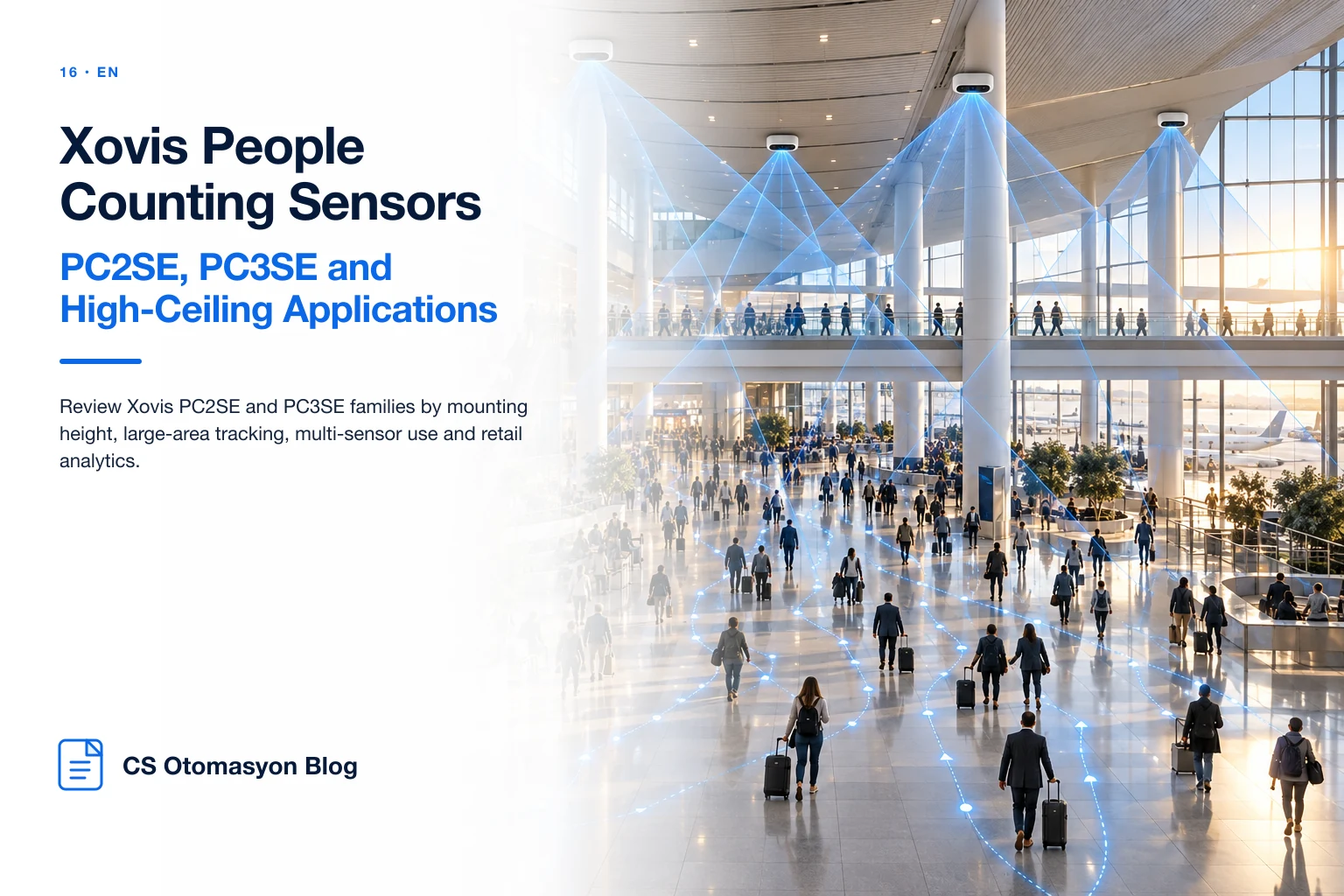
The PC3 family spans high mounting classes from roughly 6 m through specialized variants up to 20 m. Atriums, terminals and large shared spaces are precisely where dedicated high-mount optics and processing become important.
Wider coverage is useful, but the number of simultaneous trajectories also increases the importance of tracking and zone design.
Why multi-sensor deployment is more than adding devices
Covering a large area with several sensors introduces overlap, coordinate alignment and trajectory-continuity problems. A person crossing from sensor A to B should not be double-counted or lose context.
The reporting layer may also need to store a combined logical-zone metric rather than simply summing physical device counters.
The CS Otomasyon approach
In Xovis projects, CS Otomasyon starts with ceiling height and coverage geometry, then selects the appropriate PC-Series class and multi-sensor design where needed. Commissioning and logical-zone validation are part of the delivery standard for high-mount deployments.
FAQ
What is the PC2SE vs PC3SE difference?
One key difference is the target mounting-height and coverage class.
Can counting work at 20 m?
The PC3 portfolio includes ultra-high variants, subject to site validation.
Will one PC3 cover every high-ceiling site?
No. Floor coverage, obstacles and required zones matter as much as ceiling height.
Why is multi-sensor overlap used?
Controlled overlap can support trajectory continuity; commissioning should follow the vendor procedure.
Should service access be planned for high-mount sensors?
Yes. Lift access, service windows and replacement procedures are part of lifecycle cost.
Conclusion
Choose the technology against the real entrance geometry and target KPI rather than the logo on the device. A site survey and controlled pilot with CS Otomasyon can validate the architecture before rollout and connect the resulting data to centralized reporting.