
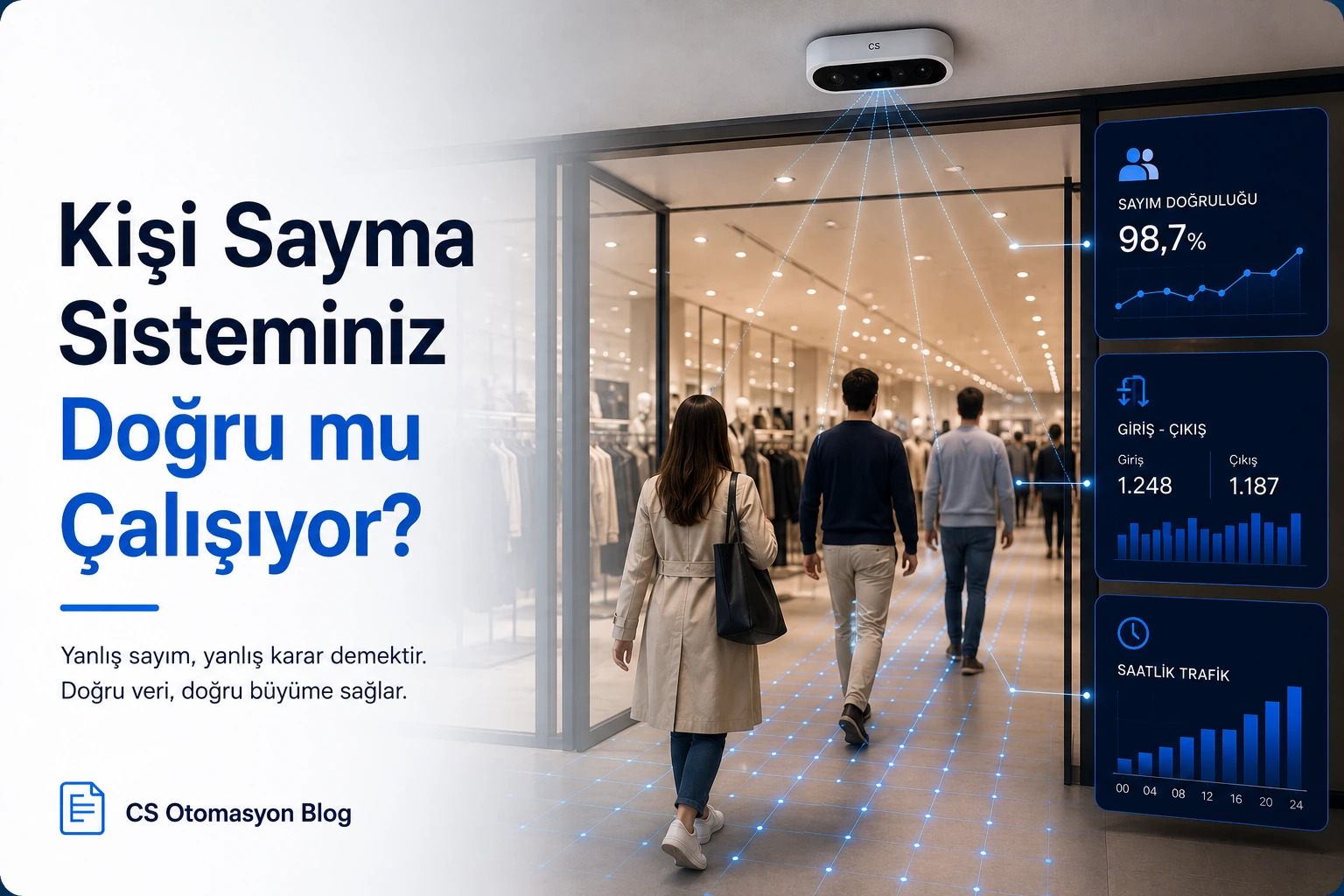
You Have a People Counting System. But Is It Working Accurately?
You Have a People Counting System. But Is It Working Accurately?
Installing a people counting system does not automatically mean you are getting reliable visitor data. In many stores and facilities, the system is installed, the dashboard is active, and daily visitor numbers are visible. But the real question is: are those numbers actually accurate?
Small mistakes in people counting systems can directly affect store performance analysis, staffing decisions, campaign evaluation, conversion rate calculations and operational planning. Inaccurate counting leads to inaccurate decisions.
1. Choosing a system based only on price
The cheapest people counting solution is not always the most cost-effective one. A low-cost system may look attractive at first. However, if it produces inaccurate data, every decision based on that data becomes unreliable.
Businesses should not evaluate people counting systems only by device cost. Accuracy, reporting infrastructure, service support, integration capability and long-term reliability are just as important.
Explore CS Otomasyon people counting solutions.
2. Incorrect camera or sensor positioning
In people counting systems, installation quality is just as important as product selection. If the camera or sensor does not see the entrance properly, cannot cover the full doorway, or is mounted at an unsuitable height, counting accuracy will drop.
- The entrance area is not fully covered
- Entry and exit directions are confused
- Blind spots appear
- The same person is counted twice
- Groups are counted incorrectly during peak traffic
The right device installed in the wrong position will not produce reliable data.
3. Not performing accuracy tests after installation
A system that appears to be working is not necessarily working correctly. After a people counting system is installed, field validation should be performed. The most practical method is to compare system data with manual counting during selected time periods.
- Manual count comparison during normal hours
- Accuracy testing during peak traffic
- Entry and exit direction verification
- Comparing dashboard data with real field observations
4. Ignoring maintenance and technical service
People counting systems are not “install once and forget” solutions. Store layouts may change, camera angles may shift, lenses may get dirty, network connections may fail, or new signs and stands may enter the camera’s field of view.
All of these can reduce counting accuracy. For businesses with multiple locations, centralized monitoring and technical service processes help protect data quality over time.
5. Looking only at visitor numbers
The purpose of a people counting system is not simply to answer the question, “How many people entered today?” The real value comes from turning visitor data into business decisions.
- Which hours are the busiest?
- Which days generate the highest visitor traffic?
- Did a campaign increase footfall?
- Is staffing aligned with visitor density?
- Does store traffic turn into sales?
- How do different locations compare?
Explore related CS Otomasyon products.
6. Not combining visitor data with POS data
One of the most valuable uses of people counting data is conversion rate analysis. Conversion rate shows how many visitors turn into customers.
For example, 1,000 visitors and 100 sales means a 10% conversion rate. If you only look at the number of sales, you cannot fully understand store performance. Real store performance becomes visible when traffic and sales are analyzed together.
7. Not using centralized reporting
For a single location, basic reporting may seem enough. But as the number of stores increases, centralized reporting becomes essential.
- Monitoring all stores from one dashboard
- Regional comparisons
- Store performance analysis
- Daily, weekly and monthly trend tracking
- Campaign period comparison
- Staffing decisions based on visitor density
8. Becoming dependent on a single brand or closed ecosystem
In people counting systems, product selection is important, but service and support after installation are just as critical. Some systems may create challenges around spare parts, software support, device replacement or technical service. This can make businesses dependent on a single brand or closed ecosystem.
CS Otomasyon works with different people counting technologies and product families to offer solutions based on operational needs. This approach helps businesses build a healthier roadmap for both new installations and existing system improvements.
Conclusion: The real value is not counting people. It is trusting the data.
The biggest mistake in people counting systems is thinking: “We installed the system, so the job is done.” In reality, the value starts after installation.
The right product selection, correct positioning, field validation, regular maintenance, centralized reporting and sales data integration all work together to turn a people counting system into a real decision-support tool.
The goal is not just to count visitors. The goal is to make better decisions with data you can trust.
Explore CS Otomasyon people counting solutions or view related products.