
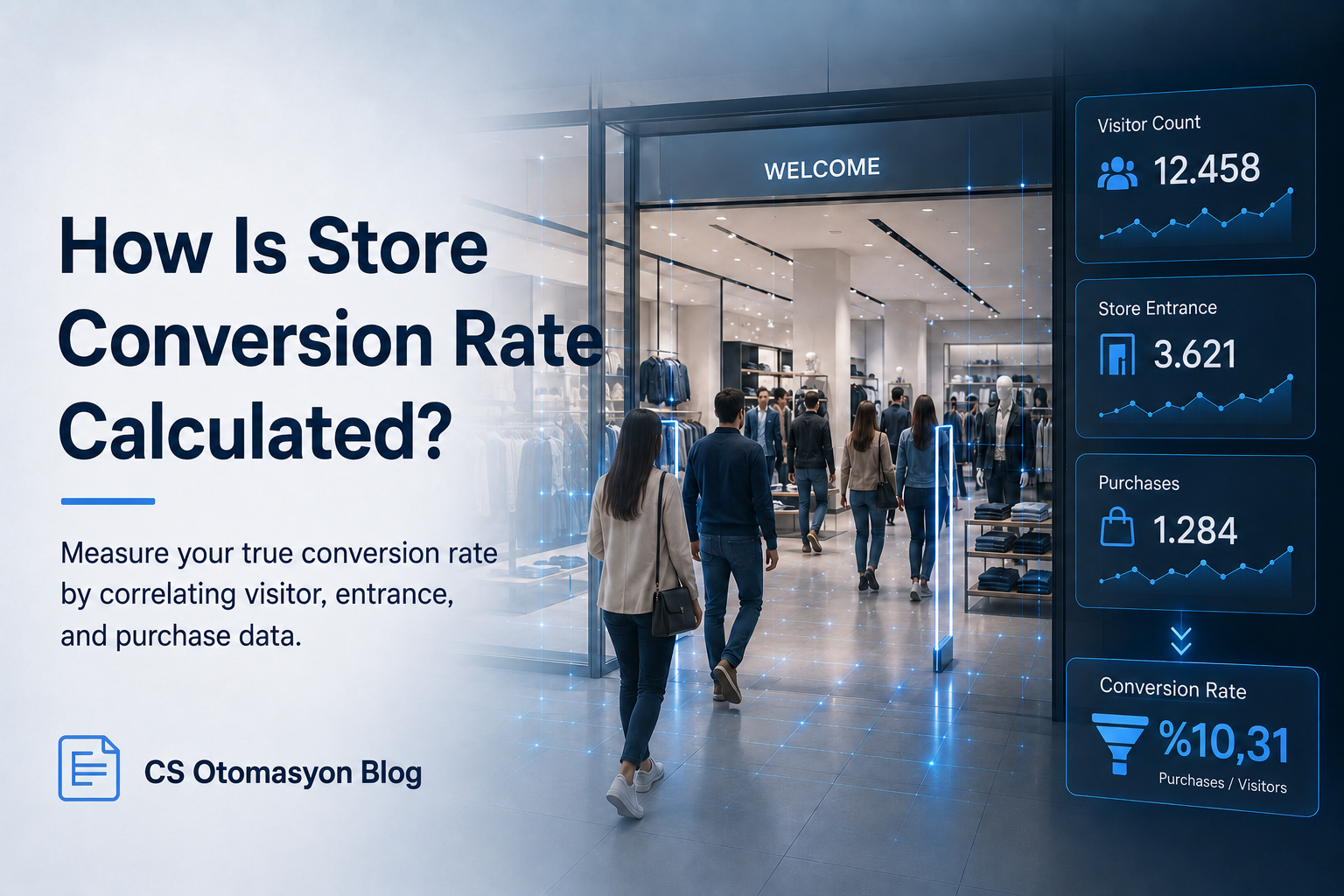
How to Calculate Retail Conversion Rate?
How to Calculate Retail Conversion Rate? Data-Driven Decisions in Retail
The traditional way to measure performance in the retail sector usually focuses on end-of-day revenue. However, in modern retail analytics, understanding what percentage of potential customers entering the store actually make a purchase is a crucial metric for evaluating operational efficiency. The store conversion rate provides businesses with valuable insights in this regard.
What is the Conversion Rate?
The store conversion rate is the ratio between the total number of visitors entering the store and the number of customers who make a purchase (receipts generated). No matter how attractive a storefront may be, if the in-store customer experience or product placement fails to meet expectations, high visitor traffic may not always result in high revenue.
Why is Revenue Alone Not Enough?
Revenue is a result; visitor traffic and conversion rates are the fundamental dynamics that influence this result. For example, a store might achieve similar revenue compared to previous months. However, if the number of people entering the store on a given day significantly increased, the conversion rate has actually dropped, and a potential sales opportunity may have been missed. Without visitor data, spotting such trends is quite difficult.
Retail Conversion Rate Calculation Formula
The generally accepted basic calculation formula is as follows:
Conversion Rate = (Number of Buyers / Total Visitors) \times 100
For instance, if an average of 1,000 people entered your store in one day and 150 receipts were generated, your conversion rate is calculated as 15%.
Tracking Conversion Rates with People Counting Systems
Instead of relying on manual estimates, using people counting hardware helps track visitor data more consistently. Traffic data obtained from sensors can be evaluated through advanced analytical scenarios integrated with POS data, depending on the project configuration.
Staff Planning and Campaign Impact: If visitor traffic increases during promotional periods but sales do not rise proportionally, it is important to analyze whether the in-store operational capacity (checkouts, staff, fitting rooms, etc.) is sufficient to handle the volume.
Comparing Branch Performances with Data
In chain stores, comparing branches solely by revenue can be misleading. Examining conversion rates provides a more objective basis for understanding which branch is utilizing its potential most efficiently.
Add Value to Your Operations
To develop data-driven strategies for your retail operations and analyze your store traffic, you can explore CS Otomasyon's people counting solutions.
Frequently Asked Questions
What is an average conversion rate?
While it varies by sector and location, values between 15% and 30% are often considered standard reference points in retail.
Is POS system integration mandatory?
It is not mandatory for basic visitor counting, but integration can be configured in projects where automating the conversion rate calculation is desired.
Are staff members included in the count?
Staff impact on the count can be minimized through height thresholds or special filtering scenarios configured on a project basis.
Should measurement only be done during campaign periods?
For a healthy analysis, continuous tracking of daily and hourly trends is recommended.
How can the conversion rate be improved?
It can be improved through staff training to enhance the customer experience, optimized product placement, and shift planning aligned with peak hours.
Explore CS Otomasyon people counting solutions or read more articles.