
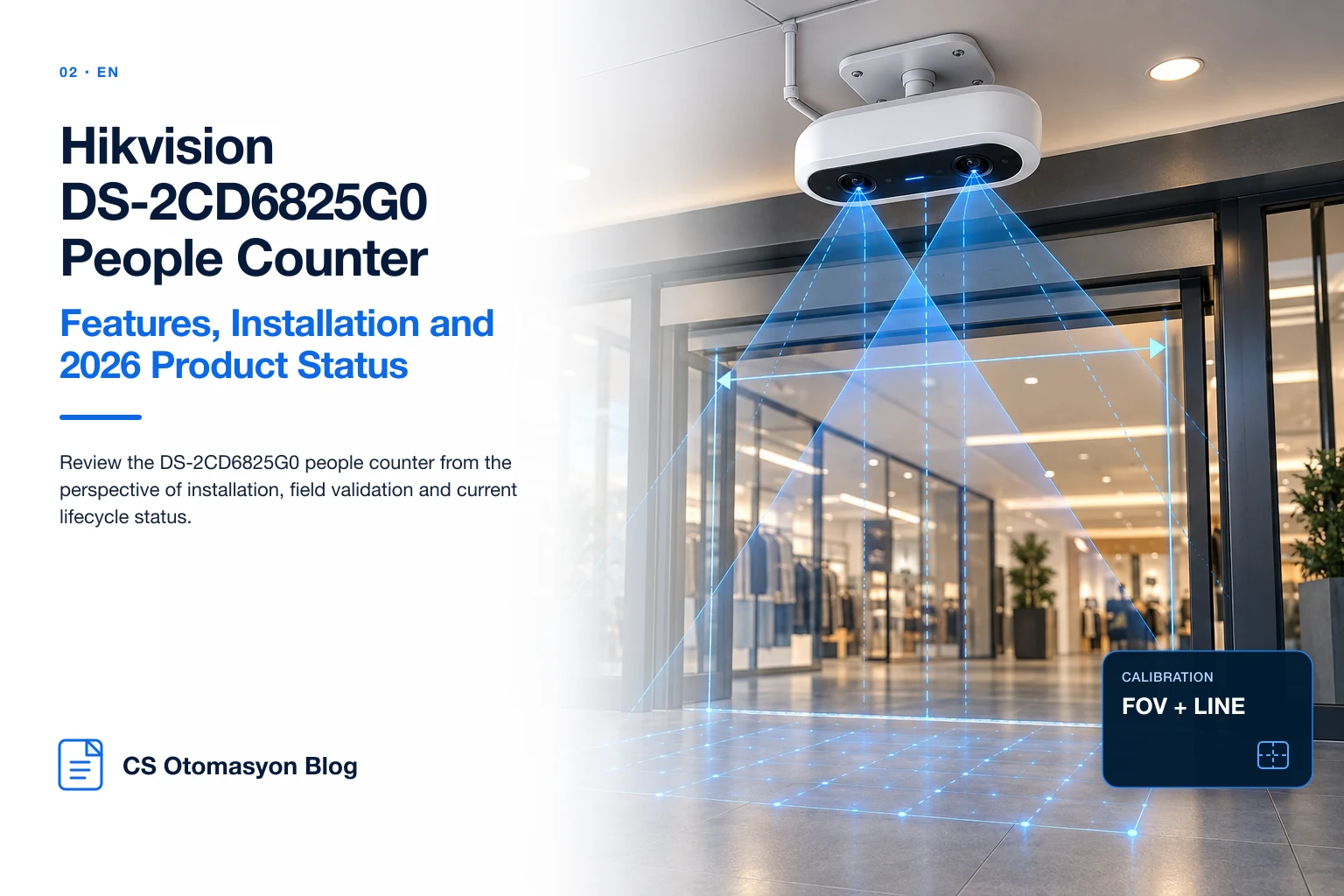
Hikvision DS-2CD6825G0 People Counter: Features, Installation and 2026 Product Status
Search intent and context
Model-code searchers usually want documentation, pricing, alternatives or compatibility, so the page should act as a buying and migration guide rather than a copied datasheet.
Technology and analytics capabilities
Full entrance coverage, reflections, direction configuration and peak-hour validation are critical installation criteria.
Limitations and field criteria
Hikvision’s current retail page marks the relevant DS-2CD6825G0/C-IV(S) family as EOL. EOL does not make installed devices instantly unusable, but it increases lifecycle and procurement risk for new rollouts.
Procurement / integration decision
Existing deployments should track device health, accuracy, firmware support and replacement strategy instead of replacing working hardware solely because of an EOL label.
Turning legacy model searches into current guidance
Model codes such as DS-2CD6825G0 remain searchable long after their peak sales period because they persist in project documents, procurement records and installed estates. Those searches are valuable, but the useful answer in 2026 is not a recycled legacy datasheet.
A strong page explains what the lifecycle status means for an installed owner, what should be checked before buying remaining stock, and how a new rollout can migrate toward a supported architecture. The model-code page becomes a lifecycle and migration resource rather than a promotional landing page.
Health checks for an installed estate
Count accuracy and data continuity should be evaluated separately. A device can count well but fail to backfill data after a network interruption, while another can remain online with a calibration problem. Daily totals, hourly anomalies and device-health signals should be reviewed together.
Firmware status, certificate management, time synchronization and spare-device availability are also part of lifecycle management. In a chain, a discontinued SKU may force a mixed-hardware estate, so the central data model should not depend on one device generation.
Why copying an old bill of materials can be risky
Reusing a proven BOM for every new store feels efficient, but an EOL device can create procurement delays, support constraints or security-policy conflicts. New platform versions may also evolve while older firmware remains static.
A more resilient standard defines acceptance criteria instead of a single SKU: entrance width, target error tolerance, output format, PoE requirement, API behaviour and field validation. Hardware can then evolve without changing the operational standard.
Preserving KPI history during migration
Hardware refresh can create an invisible KPI break if old and new devices use different rounding, time boundaries or direction rules. A short period of parallel measurement helps teams detect systematic offsets before the old counter is removed.
The objective is for the store manager to keep the same KPI definition even when the sensing hardware changes. Preserving branch identity, business rules and historical continuity in a central layer makes migration much safer.
The CS Otomasyon approach
For CS Otomasyon, an EOL product is a lifecycle and data-continuity issue, not simply a procurement label. Installed systems can be managed by risk while new sites move to supported hardware without changing the KPI and integration standard.
FAQ
Must an EOL device be replaced immediately?
No. Migration should be planned according to support, accuracy and operational risk.
How is accuracy validated?
Compare device counts with controlled manual reference counts across peak and quiet periods.
Is EOL the same as end of support?
No. Final-order or production dates can differ from hardware and software support dates.
Should old and new counters run in parallel during migration?
A short overlap is useful when the KPI is critical because it reveals systematic offsets.
Should remaining legacy stock be used at new sites?
Availability, support horizon, security and rollout risk should be evaluated together rather than deciding on price alone.
Conclusion and CTA
Choose the technology against the real entrance geometry and target KPI rather than the logo on the device. A site survey and controlled pilot with CS Otomasyon can validate the architecture before rollout and connect the resulting data to centralized reporting.