
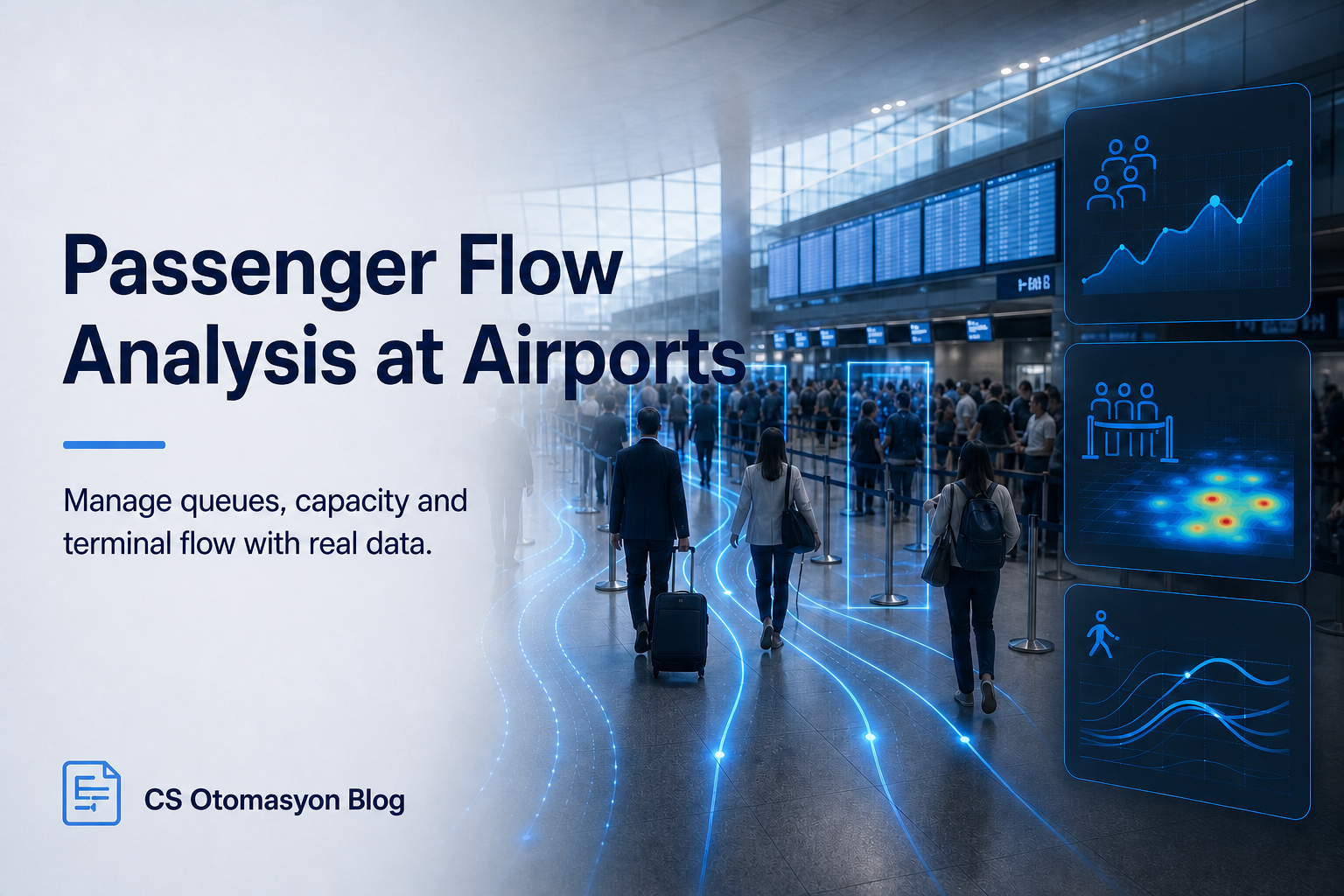
How Does Passenger Flow Analysis Improve Airport Operations?
Managing Operational Flow in Complex Terminals
Airports are among the world's most dynamic physical facilities, with high time pressure and unpredictable pedestrian traffic. The movement of thousands of passengers from check-in counters to security points, passport control and boarding gates directly determines the success of airport operations. Delays and bottlenecks do not only create passenger dissatisfaction; they can also lead to flight delays, penalties paid to airlines and significant commercial revenue losses because passengers have less time to spend in duty-free areas. Advanced passenger flow analytics systems monitor all critical points of the terminal in real time and enable intervention before a crisis forms.
Critical Analysis Points and Queue Management
In a large-scale airport operation, passenger flow is generally monitored and managed in the following sub-areas:
- Check-in and Baggage Drop: Analysis of linear or maze-like congestion and estimated waiting times in front of counters.
- Security Check and X-Ray Areas: Lane-level throughput and efficiency of open lanes in this most critical bottleneck.
- Passport and Border Control: Counter density for arriving and departing passenger flows.
- Waiting and Rest Areas (Lounges/Gates): Real-time occupancy rates and facility use around gates.
- Commercial Areas: Visitor traffic passing in front of and entering duty-free and food & beverage (F&B) points inside the terminal.
Evaluation Within International Standards
Global standards guide airport analytics projects. In particular, the Level of Service (LoS) concept defined in IATA's Airport Development Reference Manual (ADRM) evaluates passengers based on space occupied per square meter and waiting times. Flow analytics platforms can be designed to visualize their metrics according to IATA's optimum, sub-optimum or overcrowded classifications and generate alerts for the operations center (AOCC).
Wide-Area Multi-Sensor Stitching
Airport terminals are vast indoor spaces. A single camera or 3D sensor cannot cover security or counter areas alone. In these projects, dozens or sometimes hundreds of Stereo Vision or high-resolution IP cameras are combined on the same network. The system algorithm follows an object/passenger leaving one camera's field of view in another camera's field of view and creates an anonymous motion vector. This allows the process time from point A to point B to be measured more consistently.
Real Use Case: Increasing Non-Aeronautical Revenue
Reducing the time spent in security and passport queues can increase the time passengers can allocate to other areas inside the terminal. Its impact on commercial performance should be measured separately according to the airport's passenger profile and store layout. An airport operator, thanks to an early warning from the flow analytics system stating "Security queue waiting time exceeded 15 minutes", immediately opens 3 new X-Ray lanes. Waiting time is brought back down to 7 minutes. Passengers who pass earlier spend more dwell time in commercial areas before boarding. Such operational interventions can support passenger experience and accessibility of commercial areas. Revenue impact should be measured separately according to airport scale, passenger profile, flight schedule and commercial area layout.
Limitations, Privacy and Technical Requirements
In airport projects, cybersecurity, access permissions, system continuity and data governance under KVKK/GDPR should be handled as part of project requirements. The operational people counting scenario discussed in this article can be designed to produce anonymous and aggregated flow data without needing to process face or passport information. The technology and integration scope to be used should be evaluated separately. In addition, sensors used in airports must have advanced AI algorithms capable of filtering people from heavy luggage, strollers and wheelchair traffic.
CS Otomasyon Approach
CS Otomasyon provides not only sensor hardware but also video intelligence software that supports wide-area monitoring capabilities. In airport projects, project-specific integration options can be evaluated in coordination with field teams, and the system can be configured according to the airport's unique dynamics.
Correct Boundaries for Using LoS Data
IATA's Level of Service approach provides criteria such as area, maximum queue time and seating capacity for planning terminal subsystems. However, LoS alone does not mean continuous operational quality measurement or an automatic investment decision. According to IATA's official explanation, the method should be interpreted by experts within the context of typical busy periods, design date and the relevant subsystem.
LoS can be used in specific terminal components such as check-in, security, passport control, gate waiting areas and baggage claim. Applying the same thresholds directly to retail areas, restrooms and general circulation zones is not correct. In these areas, the operator's own service targets, cleaning capacity, commercial performance indicators and passenger experience research should be used.
The operational flow system should be positioned not as a decision engine that applies the IATA framework by itself, but as a measurement layer that presents real-time traffic, queue and occupancy data to relevant teams. Decisions such as opening a new control lane, directing staff or closing an area should be made through authorized operations teams' procedures.
- Planning metric: Comparing design capacity and typical busy hour.
- Operational metric: Actual queue, waiting and processing speed.
- Experience metric: Passenger satisfaction and service perception.
- Commercial metric: Traffic, dwell time and sales performance of the relevant area.
This distinction allows international guidelines to be used without removing them from their context and enables measurement data to support authorized teams' decision processes.
Operational Ownership and System Resilience
Which team will monitor passenger flow data and who will decide when a threshold is exceeded should be defined in advance. Terminal operations, security, ground services and commercial units may use the same data for different purposes. Without shared indicator definitions and an authority matrix, conflicting actions may occur for the same density event.
- Escalation: Alert levels and responsible operational roles.
- Resilience: Safe operation and manual procedure during network or sensor interruption.
- Data quality: Monitoring blind spots, duplicate counts and missing time intervals.
- Privacy: Documenting purpose, access, retention and sharing rules.
In critical environments such as airports, pilot testing should cover not only normal days but also peak periods and failure scenarios. The system provides decision support; security, capacity or passenger routing decisions are implemented through relevant regulations, airport procedures and authorized teams' evaluation. In this way, the analytics layer strengthens coordination rather than replacing operations.
FAQ
Is biometric face recognition used while tracking passengers?
No. Face recognition is not used in operational crowd and queue management projects. Data is processed entirely as anonymous numerical groups.
Is integration with airport AODB possible?
Through project-based development processes and protocols permitted by airport management, the potential for cross-data integration with flight information systems can be evaluated.
How is queue waiting time calculated?
Sensors measure the time between a person entering the start of the queue and leaving the queue end (counter/desk), then estimate the waiting time for people behind by dividing the number of people waiting by processing speed.
Do luggage and strollers distort counting?
Sensors capable of 3D depth perception and size/shape analysis distinguish human physiology from luggage-type objects and filter them.
Conclusion
Turning invisible bottlenecks in airport operations into data improves passenger comfort and commercial efficiency at the same time. To review our transportation-sector solutions and request a facility discovery, you can contact our specialists.