
AI-Based Occupational Safety and Safe Pedestrian Path Tracking in Industrial Facilities
Safely Managing Human-Machine Interaction on the Factory Floor
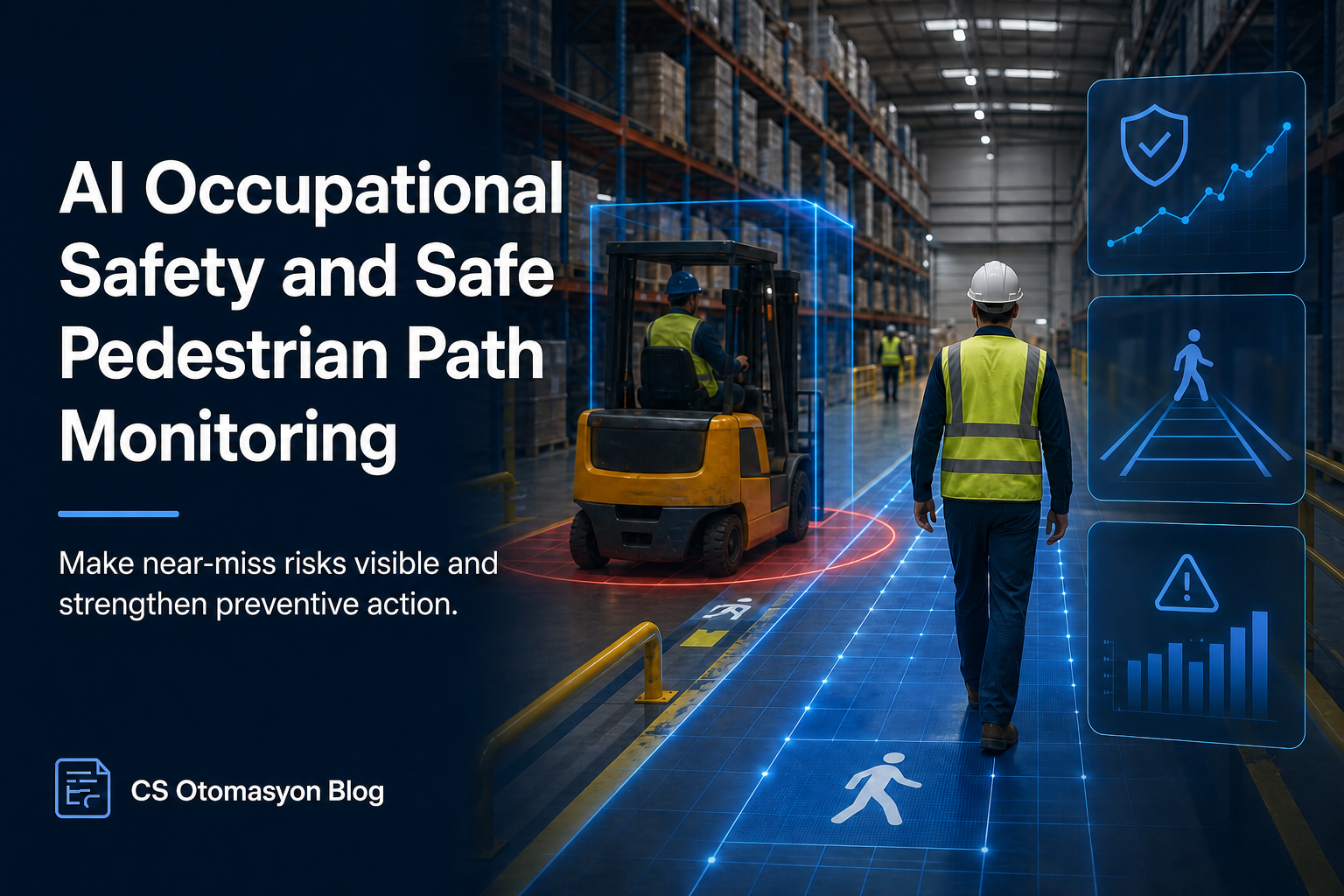
Heavy industrial facilities, production lines, logistics warehouses and ports are very high-risk environments where large work machines such as forklifts, pallet trucks and cranes share the same physical space with pedestrian staff. According to Occupational Health and Safety (OHS) laws and procedures, floors are painted with yellow lines to separate pedestrian paths and vehicle roads with clear boundaries. However, because of the high tempo on site, staff distraction, shortcut habits or forklift operators' blind spots, floor lines are frequently violated. AI-powered OHS tracking platforms aim to turn existing security cameras into virtual OHS inspectors that continuously monitor floor lines day and night and detect danger before an incident occurs.
How It Works: Virtual Zones and Proximity Algorithms
The heart of OHS video analytics is the ability of Deep Learning models to interpret and classify pixels seen in the field. The system works through these stages:
- Object Classification: The algorithm aims to distinguish object classes such as humans, passenger vehicles and forklifts in camera footage. Actual performance should be measured through acceptance testing according to camera angle, object size, lighting and field conditions.
- Virtual Zone Violation: Polygon virtual zones are drawn in the software interface to match the yellow lines on site. If a forklift enters a Pedestrian Only zone or a pedestrian enters a Forklift Only area, this is logged as a rule violation.
- Dynamic Proximity Analysis: Independently of floor lines, a virtual protection shield, for example a 3-meter diameter circle, is created around a moving work machine. If a person enters this distance, the system records it as dangerous proximity (near-miss).
- PPE Tracking as a Complementary Module: Through the same camera view, whether the person committing the violation is wearing a vest or helmet (Personal Protective Equipment - PPE) can be evaluated with an additional analytics algorithm that may be integrated.
Critical OHS KPIs That Can Be Measured
After the system is installed, the OHS managers' dashboard can show the following data:
- Hourly/Daily Pedestrian Path Violation Count: Identifying which shifts and days show the most rule relaxation.
- Highest-Risk Areas (Risk Heatmap): Hot spots in the facility where violations are most concentrated on a map, such as blind corners.
- Near Miss Event Frequency: Numerical trend of forklift-pedestrian proximity events that did not become accidents but carry potential accident risk.
Real Use Case: Blind Corner Violation Detection
At an automotive spare parts factory, dangerous proximity events frequently occur at an intersection of corridors. The OHS manager connects the Safe Pedestrian Path algorithm to the existing camera watching that area. Data is collected and reported for two weeks: during the night shift between 02:00 and 04:00, operators carrying materials are found to violate the yellow line and turn through the pedestrian corridor. The situation is identified before an accident occurs. If an automation relay is connected to camera analytics within the project, a light or audible warning can be triggered when a forklift approaches the pedestrian area. The warning type should be determined according to field risk analysis, occupational safety procedure and existing automation infrastructure.
Limitations and Camera Positioning
Environmental conditions and infrastructure limitations should be considered in this analysis model. Efficient results cannot be obtained from older-generation cameras that do not have suitable resolution, angle and FPS values. In industrial areas, mounting cameras on vibrating surfaces such as crane columns disrupts analysis; a stable mounting point is required. In dusty facilities, air purge housings are required because cameras whose lenses become covered with dust will become blind.
Most importantly, an AI OHS system is not a magic shield that prevents accidents by itself; it does not replace physical barriers or OHS training. It is a supporting data collection and early warning layer that measures and makes the existing OHS culture visible.
CS Otomasyon Approach
CS Otomasyon is not only a software supplier; it designs video automation projects that bridge your field cameras and warning systems such as sirens, panels and automatic doors. The aim is not only to write data to a report in case of violation, but to create action by triggering field devices.
Risk Analysis, Pilot Implementation and Acceptance Test
Before OHS analytics is installed, the facility's existing risk assessment should be reviewed; forklift routes, blind corners, loading areas and pedestrian crossings should be prioritized. Camera installation should not be used as a solution that hides a lack of physical barriers or field lines. First, basic engineering and occupational safety measures should be implemented, and the analytics system should support these measures.
During pilot implementation, controlled scenarios are run with different shifts, lighting conditions, work clothes and vehicle types. Pedestrian path violation, dangerous proximity and vehicle zone violation are tested separately. Whether each alarm reaches the correct object classification, correct zone rule and expected notification channel is recorded.
- Risk priority: Selecting the near-miss areas that are most frequent and have the most severe potential outcomes.
- Visibility sufficiency: Testing blind spots, vibration, dust and lighting changes.
- Alarm load: Avoiding more warnings than the operator can manage.
- Physical action: Designing the siren or beacon so it does not direct the employee toward a new risk.
- Periodic validation: Retesting rules when the camera or field layout changes.
Acceptance criteria should not consist only of total accuracy percentage. The missed rate of critical violations, false alarm frequency, notification delay and the OHS team's response time should be evaluated together. System outputs can be used in training, field arrangement and preventive action plans; however, legal OHS responsibility and human oversight continue.
Success Measurement and Continuous Improvement
The success of the system should not be measured only by the number of alarms produced. Too many alarms can create alert fatigue among employees; too few alarms may mean critical violations are being missed. The OHS team should monitor alarm quality together with field behavior and risk indicators.
- Leading indicators: Dangerous proximity, pedestrian path violations and near-miss frequency.
- Outcome indicators: Injury, material damage and stoppage events.
- Intervention: Time to verify the alarm and complete field action.
- Improvement: The impact of training, markings, barriers or traffic direction changes.
Results should be reviewed regularly with the OHS committee and field employees. The aim is not punishment, but making recurring risk patterns visible and strengthening preventive action. When camera position, field lines or working method changes, the measurement baseline should be renewed; these changes should be clearly noted when comparing with previous periods.
FAQ
Are all our existing cameras suitable for OHS analytics?
IP cameras that see the target area with sufficient clarity and a suitable angle can potentially be evaluated. Required resolution, frame rate and lens selection should be determined according to the image size of the object to be detected and field geometry. Angle suitability should be reviewed on a project basis.
How does the system alert at the moment of violation?
Within the project scope, integrations can be designed with I/O relays, field beacons, sirens or notification software. Delivery of event photos or clips to authorized people depends on system architecture, access policy and the organization's data management preferences.
Does the forklift brand or model affect analysis?
The model's purpose is not to recognize brands, but to distinguish vehicle classes taught or supported within the project. Different forklift, pallet truck and work machine types should be separately validated during pilot testing.
Where is footage stored?
The image processing architecture can be designed according to project requirements in the business's own data center, on Edge devices or in another infrastructure with suitable security controls. Cloud use is not mandatory; the preferred architecture should be evaluated together with data minimization, access and retention policies.
Conclusion
Managing OHS standards in your facility based on data instead of assumptions is one of the most modern ways to protect human health and reduce operational risks. To explore site-specific scenarios, you can contact our technical sales engineers.