
How Does AI-Based Fire and Smoke Detection Work?
The Importance of Early Warning in High-Risk and Wide Areas
In industrial facilities, logistics warehouses, outdoor storage yards and chemical plants, fire is one of the greatest risks threatening business continuity and life safety. Traditional point smoke detectors, which are mandatory in buildings, operate on the principle that smoke particles physically reach the sensor chamber on the ceiling and reach a certain density. However, in very high-ceilinged, strongly ventilated or fully outdoor areas, the behavior of smoke reaching a point detector can vary depending on environmental conditions. This physical limitation can allow a fire to reach an uncontrollable scale. AI-based visual fire and smoke detection systems analyze the first signs of smoke and flame patterns in the camera's field of view and provide a critical complementary early warning layer.
How It Works and Deep Learning Algorithms
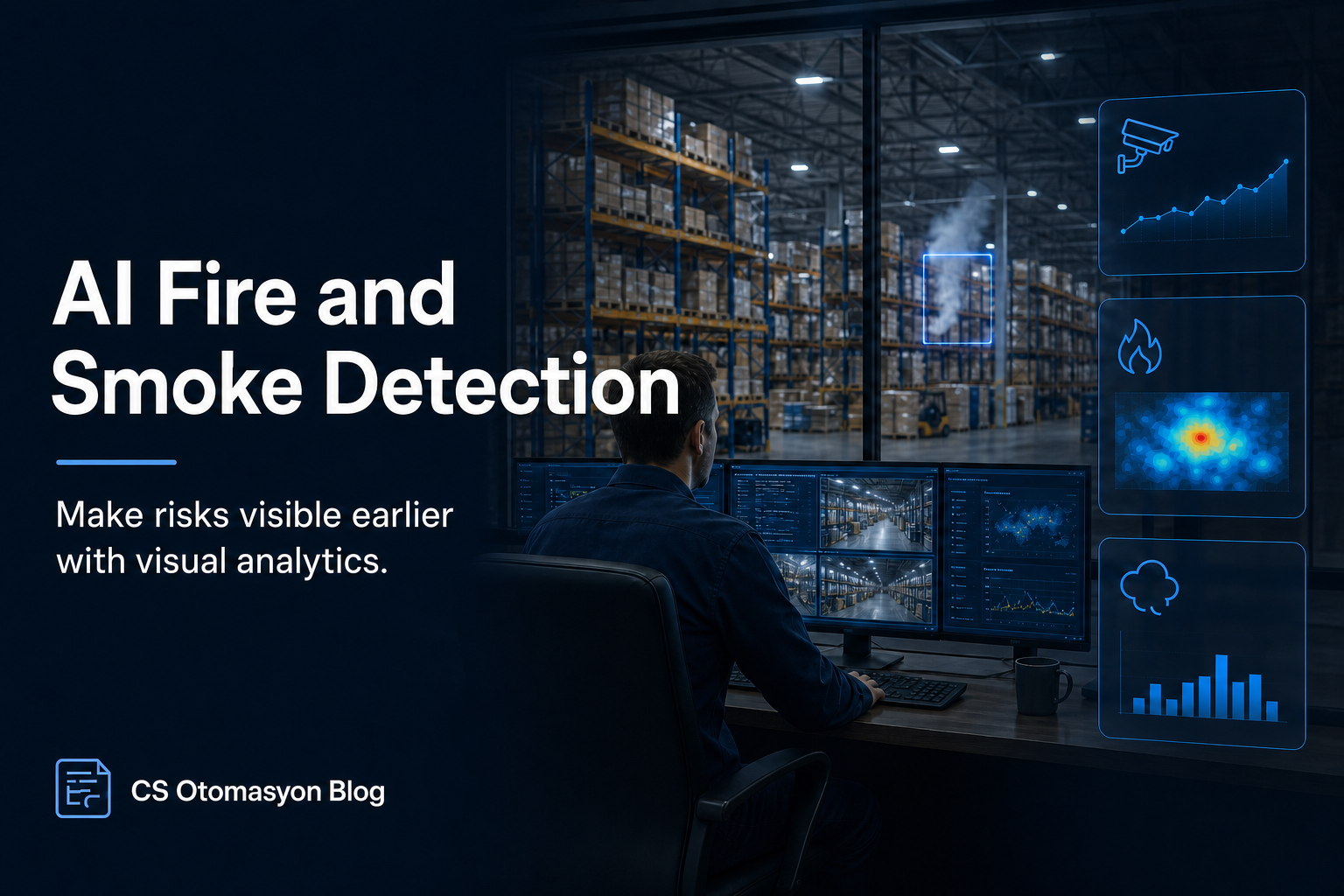
Visual fire detection systems analyze live video streams from standard security cameras with Deep Learning models developed to distinguish fire and smoke patterns.
- Smoke Form Analysis: The algorithm analyzes not only a gray color, but also the upward expansion movement of smoke with vortex-like behavior, opacity level and edge softness across consecutive video frames.
- Flame Characteristic Detection: The flame's specific color spectrum (a high-contrast core of red, orange and yellow), rapid flicker frequency per second and sudden changes in pixel brightness (luminance change) are detected.
- Regional Masking: Areas that continuously generate smoke, steam or sparks due to the production nature of the facility, such as welding zones or exhaust outlets, are excluded through software masking so the system does not generate alarms from those areas.
Critical Warning: Legal Framework and Complementary System Positioning
Important Legal Limitation: Camera and AI-based visual fire detection systems are not a legal alternative to, or a replacement for, physical approved fire detection and alarm systems (addressable detectors, call points, sirens) that are required under current legal regulations such as fire protection regulations and NFPA standards. This technology should be positioned as a supporting and complementary early warning layer that supports the business's existing legal infrastructure and provides visual verification where point systems are weak, such as outdoor areas or high ceilings.
Real Use Case: Outdoor Yard Fire at a Recycling Facility
A large paper and plastic recycling facility has an outdoor storage yard covering hundreds of square meters. Because it is open air, installing traditional smoke detectors is impossible. In summer, small smoldering events that start when glass fragments inside the waste focus sunlight can cause major fires at the facility. The facility integrates an AI analytics server with cameras on high poles overlooking the yard. A small gray smoke cluster rising from between waste piles at an early stage is detected by the software even though it disperses in the wind. Event imagery and a project-defined alert are transmitted to the security room. Authorized staff verify the image and initiate the response process according to the facility's emergency procedure. This example is only a possible project scenario; detection and response time depends on field conditions.
Limitations, False Alarms and Maintenance Requirements
The most difficult test for visual detection technologies is environmental conditions. In factories, steam from production, forklift exhaust, heavy fog entering the field, welding sparks or sunlight reflections on the floor can mislead algorithms and produce False Positive alarms. Modern systems reduce these rates by applying temporal filtering, such as steam disappearing within seconds while smoke grows. In addition, system performance depends directly on the camera's line of sight; when the camera lens gets dusty or a pallet blocks its view, that area becomes blind. Periodic lens cleaning and lighting are essential.
CS Otomasyon Approach
CS Otomasyon does not only provide software; it analyzes risk factors in your site such as dust, steam and light bursts, and fine-tunes the AI model for your facility. In our projects, we extend the capabilities of our platform by designing integrations that deliver a snapshot of the detected event to relevant units via Telegram, email or VMS screens.
Designing Alarm Verification and Response Flow
The value of a visual detection system does not come only from producing alarms, but from delivering the alarm to the right person with understandable context. At the start of the project, it should be defined which camera image, which priority level and which communication channel will be used to deliver the event. Operator verification of the alarm should be compatible with the facility's existing emergency plan and authority chain.
Alarm records can be reviewed regularly to classify repeated false alarm sources such as steam, dust, welding light or exhaust. When region masking or threshold adjustment is performed, care must be taken not to make a real fire risk invisible. Therefore, settings are managed according to the balance between reducing false alarms and not missing risky events.
- Event priority: Classification according to smoke, flame or thermal anomaly type.
- Visual verification: Authorized staff review live view or event clip.
- Escalation: Transfer to security, occupational safety or emergency teams according to facility procedure.
- Record: Logging alarm time, verification result and action taken.
- Periodic test: Testing camera view, notification channel and integrations through controlled scenarios.
Camera-based analytics cannot see a fire outside its field of view and does not assume the role of approved physical detection systems. The safest approach is to use visual analytics as a complementary layer together with existing detectors, fire panel, facility procedures and trained personnel.
Maintenance and Controlled Validation
The performance of fire and smoke analytics can be affected when camera view changes, the lens becomes dirty or the production process creates new steam and dust sources. Therefore, the system should be revalidated not only on the installation day, but at defined intervals and after field changes. Tests should be performed with controlled methods aligned with the facility's occupational safety and fire procedures.
- Camera health: Checking video loss, blur, direction change and night vision.
- Notification test: Confirming that the alarm reaches the right person with the right priority and context.
- Event review: Root-cause analysis of false alarms and missed events.
- Change record: Documenting threshold, region or model updates.
The maintenance plan should not be considered separately from the legal testing and maintenance obligations of approved fire detection systems. A successful test result for camera analytics does not replace the test of a smoke detector, flame detector or fire panel. All layers working together strengthen the facility's emergency preparedness.
FAQ
Does AI smoke detection work in the dark?
Because it is based on image processing, the light emitted by flame can be detected easily in dark environments; however, for smoke to be detected in darkness, the site must be illuminated or the camera's strong IR lighting must be sufficient to make the smoke visible.
Can the system distinguish a smoke-generating machine from a fire?
If a specific area continuously produces smoke/steam, that area, such as a chimney outlet, is masked from the interface; abnormal smoke outside that machine is still detected as an alarm.
Can this system notify the fire department directly?
Within the project scope, event signals can be evaluated for transfer to the fire panel, building management system or alarm management software through dry contact or API. Notification to official emergency units should be carried out through the facility's approved procedures and authorized personnel; it should not be assumed that the system makes an automatic call by itself.
Do cameras have to be thermal?
No. Standard RGB (color) optical cameras can also analyze smoke and flame form with deep learning. Thermal cameras are evaluated through separate project design to detect heat increase (radiometric measurement) before flame appears.
Conclusion
Detecting risks at the earliest stage in your high-ceiling warehouse, outdoor yard and industrial facilities is a safeguard for business continuity. For a camera analytics discovery suitable for your facility's risk structure, you can plan a technical assessment with CS Otomasyon.